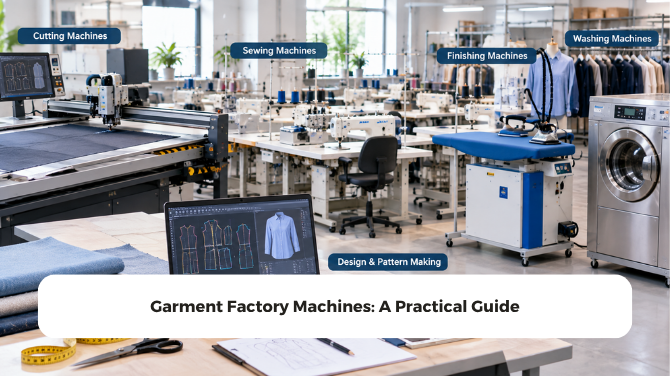
Starting a garment manufacturing business involves much more than buying sewing machines. The right garment factory machines depend on the products you plan to manufacture, their construction, production volume, and the processes your factory will handle.
A small unit making shirts will have different machine requirements from a factory producing T-shirts, leggings, jeans, or other products. This guide explains the main machine and equipment requirements across stitching, cutting, and finishing.
It is good news that you are also interested in setting up your garment business, like many other entrepreneurs. I want to let you know that this is a common question everyone asks about machines and necessary equipment requirements for starting a garment business. I have written replies to this question many times. One such question: “I want to start garment manufacturing on a small scale. What all machines do I need to purchase for my factory?”
Today I am writing an extensive post on this question. I am not just answering your question directly by giving a fixed list of sewing machines, but I will be discussing it with examples – things based on which machine types are planned for a new set-up.
Are you looking for types of machine requirements for the stitching section only? Knowing only stitching machines is not enough for running a garment manufacturing business. You will need cutting machines, garment pressing machines, washing machines, and more.
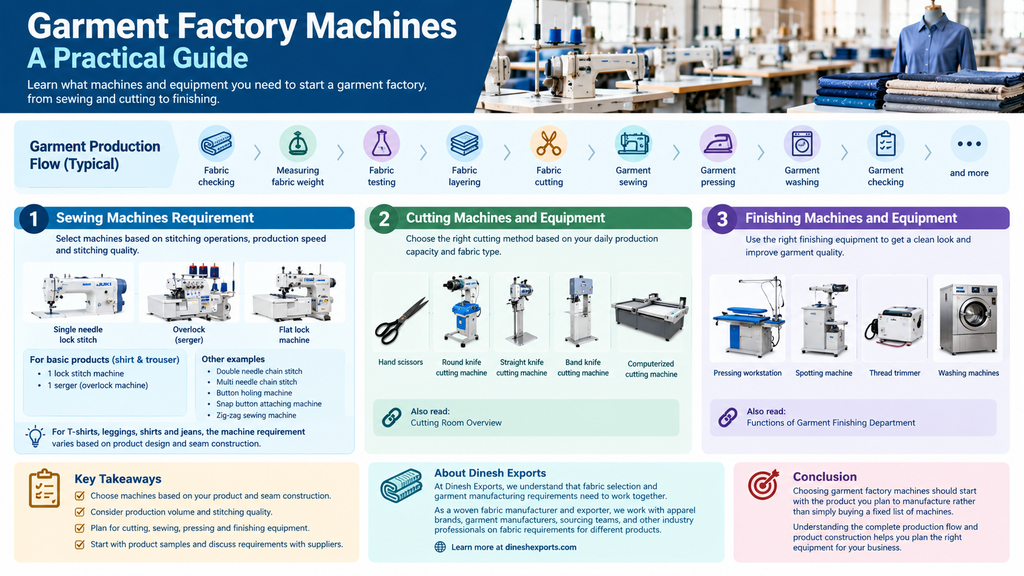
Look at the processes that you need to follow. A common flow of a garment unit is likely (where machine or equipment is required):
Fabric checking — measuring fabric weight — fabric testing – fabric layering –fabric cutting –garment sewing –garment pressing –garment washing –garment checking and more
1. Sewing machine requirements:
You have to select sewing machines according to the stitching operations (seam construction) to be used in the garment design. You might have multiple options for selecting a stitching machine for stitching one seam. But for mass production, you have to look at production speed and stitching quality as well. Based on these two factors, you have to select sewing machines that suit best for the operations. Based on these two factors, you have to select sewing machines that suit best for the operations, such as a Juki Electric sewing machine known for its durability and efficiency
If you want to start with a minimum number of machines for making basic products like shirts and trousers, you must have one lockstitch machine and one serger (overlock machine). Visit a tailoring shop near your house; you will get to see these two types of sewing machines. They use hand scissors for cutting garment parts and use a hand press (iron) to press the garment.
Traditional tailoring shops mostly use black head lock stitch sewing machines. For mass production, it is recommended to use industrial sewing machines.
Examples:
- To make T-shirts in bulk, you need machines like single needle lock stitch, Overlock, and flat lock machines.
- To make leggings, you need machines like overlock and flat lock.
- To make a shirt, you need machines like single needle lock stitch, overlock, buttonhole, and button attach. These are the minimum requirements.
You can extend this list by adding operation-specific machines. Remember, machine requirement is completely depend on the styling of the products.
For the same product, you might need different types of sewing machines due to product design variation. For making styling T-shirt, you may need machines like a double-needle chain stitch machine or a multi-needle chain stitch machine. Overlock machine with a back latch, a buttonholing machine, a snap button attaching machine, or a zig-zag sewing machine. In the overlock machine series, there are 3-thread overlock, 4-thread overlock, and 5-thread overlock machines. You may need all these 3 types of overlock machines for making a T-shirt.
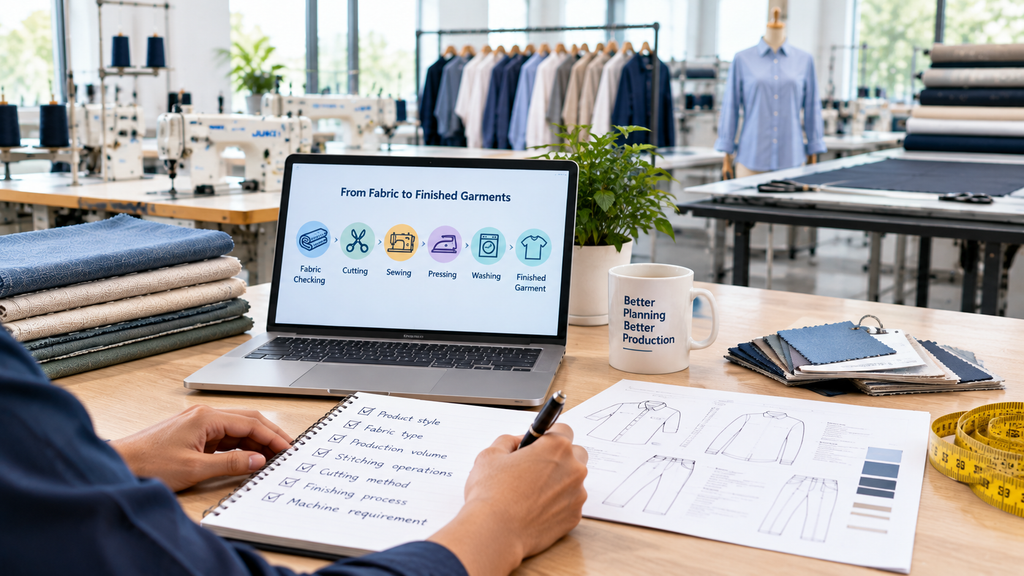
The best way to decide machine requirement is collect your product sample and check product construction detail (seam construction) and according to that prepare machine requirement. Secondly, you might have selected multiple products for your project (garment business). In that case, you can share the same machine for stitching different products.
I know you are new to this business; just having one garment sample can’t make the list of machine requirements. You can contact us for understanding machine requirements for your project. While you are contacting me, be specific about the product name that you will be making in the set-up and product design in the given product categories. I hope you understand why I am telling you to be specific about product categories and product design.
Related Articles
- Fabric GSM Explained
- How to Calculate Fabric Consumption of a Garment
- Cotton Woven Fabric: Benefits and Types
- Types of Woven Fabric Explained
- Woven Fabric: Everything You Need to Know
Nowadays, many automatic and semi-automatic sewing machines are used in the stitching section. Like jeans back pocket making (folding pocket edges and hemming) and pocket attaching machine, auto pocket welting machine for trousers and jackets.
2. Cutting machines and equipment
For cutting garment components from fabric sheets, you have many options to cut the fabric. Such as hand scissors, Round knife cutting machine, Straight knife cutting machine, Band knife cutting machine, and computerized cutting machine. Based on production daily capacity/requirement, you have to choose one or multiple tools for cutting fabric. For example, if you want to make 50 shirts daily, you have to cut at least daily. For that many pieces, a round knife cutting machine is enough. But yes, you alternatively can use straight knife cutting machine or hand scissors.
3. Finishing machines and equipment:
You need a garment pressing machine to iron garments to remove all creases in the garment and to give a nice look to the garments. You can use a hand press (steam press), or you can install a pressing workstation having a vacuum table and inbuilt steam boiler. See the image below for the pressing workstation.
Other equipment like spotting machine, thread trimmer, washing machines are required for garment finishing.
Once you are ready with your business plan or at the stage of preparing a draft of your business plan, you can contact sewing machine suppliers. They will give you a list of sewing machines required for your product(s).
About Dinesh Exports
At Dinesh Exports, we understand that fabric selection and garment manufacturing requirements need to work together. As a woven fabric manufacturer and exporter, we work with apparel brands, garment manufacturers, sourcing teams, and other industry professionals on fabric requirements for different products.
Our focus is on supplying woven fabrics for apparel applications, with attention to fabric construction, GSM, composition, design, and end use. These factors can be important when planning garment production and evaluating fabric requirements for different products.
Learn more about our company and capabilities at Dinesh Exports.
Conclusion
Choosing garment factory machines should start with the product you plan to manufacture rather than simply buying a fixed list of machines. Garment construction, production volume, stitching operations, cutting requirements, and finishing processes all influence the equipment needed.
For a new garment business, understanding the complete production flow can help you plan the machine requirements more practically. Starting with your product samples and construction details gives you a clearer basis for discussing requirements with machine suppliers.