In garment manufacturing, the production efficiency is determined by the number of clothes produced by a sewing line and the amount of time lost during the working shift. Production time can be lost due to machine breakdown, material shortages, quality issues and line setting.
A Non-Productive Time (NPT) report allows factories to record these losses, identify their causes and see where improvements are needed. This article explains how garment factories can capture NPT and how the report can be used to improve production performance.
What is Non-Productive Time (NPT) in Garment Manufacturing?
NPT in Industrial Engineering term is Non-Productive Time. The time that is spent by an operator without producing any garment (standard minutes) like ‘set up time’ is called nonproductive time. In garment production, non-productive time is measured to analyze how much standard time is lost due to machine downtime. A report is made by recording machine downtime or lost time is called NPT Report. And this is as essential MIS report where factory value each standard minute of its operators.
In most factories, Industrial engineers are responsible for recording and analyzing line wise NPT for the factory. Mostly printed formats are used to record non-productive time. How much time is lost in a line is recorded as because operator wise NPT recording is near to impossible in manual tracking? Non-productive time includes criteria where major time lost.
Lost time is recorded to show management a reason for low production in a particular day or lower line efficiency. Here is few example of lost time.
- Line setting – time lost at the time of setting up the line for new styles.
- Machine Breakdown
- Cutting not available
- Stitching Quality issue
- Cutting quality problem
- Power failure
- Change of Feeding Plan
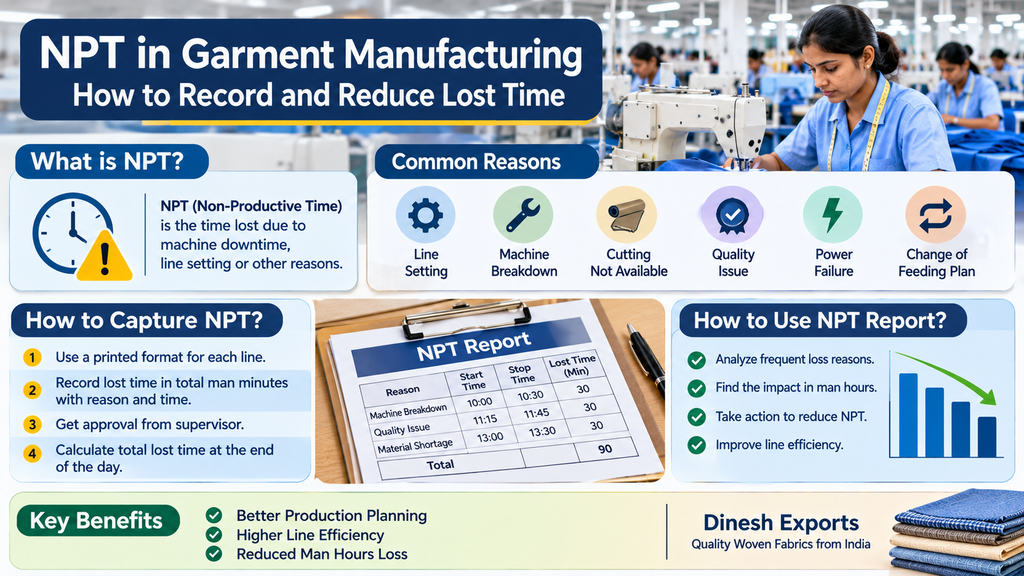
A sample NPT format has been shown below for your reference. Reasons of NPT may be different in your factory. So make your own list of NPTs those occur frequently in your factory. For example, the operator sits idle due to delay in accessory receiving/approval may frequently occur in some factories and it may not happen at all in another factory.
How to capture NPT?
Provide a printed format to each line. Make one person responsible (line feeder, work study officer or line supervisor) to record lost time in total man minutes in the format. During production hours whenever you see operators to sit idle, find the reasons of not having work (or not doing the task) and note down start time and stop time, as shown in the above sample format. In case multiple operators are sitting idle for the same reason multiply lost time by number of operators to calculate total man-minutes lost and record on your NPT format.
Lost time recorded under the category need to be approved by supervisor or authorized person.
At the end of the day calculate total lost time in each category.
How to use NPT report for process improvement?
Once you have collected lost time report of a line for a period of a month you can analyse and find which NPT parameters are occurring at higher frequency. You will get clear figure how many man hours are lost due to presence of those NPT parameters in the process. All these lost man-minutes can be converted into productive minutes by improving processes and strong production planning. Now you need to think upon reducing the major lost time parameters. Do root cause analysis for occurring lost time and take an improvement project to reduce valuable standard hours.
Conclusion
The NPT report provides garment factory management with a clearer picture of where they are losing production time. Industrial engineering and production teams can identify recurring problems by tracking downtime by reason, calculating lost man-minutes, and reviewing the results regularly.
Next step is to look into the major causes and take corrective action. Reducing non-productive time, whether it be machine break down, material availability, quality or line setting, can make factories use available working hours in a better way and improve line efficiency.
About Dinesh Exports
Dinesh Exports has been manufacturing woven fabrics in India since 1994 and has experience in fabric manufacturing, dyeing and weaving. We provide design led woven fabrics for mens, womens and childrens apparel to fashion brands, retailers, garment manufacturers and sourcing teams.
Our collections of fabrics Made in India include a variety of woven constructions, designs and finishes. We understand the importance of production planning, availability of materials and consistent quality to support the garment manufacturing operations. If you need more information, please contact us.