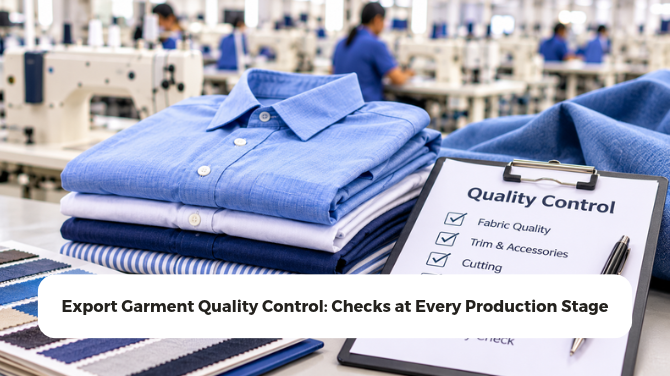
Quality control of garments is not only about the final inspection before shipping. Then it goes to cutting, stitching, finishing, washing and packing. It starts with inspection of raw material. If a problem is not noticed in its early stage, it can affect the whole production order.
A good quality control system helps garment producers find flaws at an early stage, satisfy the specifications of the buyer, reduce the amount of rework and provide consistent products. Key Quality Checkpoints Followed across Different Departments in Garment Manufacturing – This article describes the key quality checkpoints followed across different departments in garment manufacturing.
Check out our digital swatch here
Quality Control Practices in Garment Manufacturing
Product and service quality plays a significant role in business sustainability. The same thing applies to garments as a product. In the buyer’s market, quality is the core of a business for what it gets acceptance and credibility among its clients. Each garment manufacturing business must implement a quality control system and follow quality control processes. In this production process flow the quality checkpoints are shown in the chart.
This article shows quality control practices followed by most of the organized garment export houses. Each production department deploys a quality control team including a quality controller, quality inspector, and auditor. This is to ensure that the department moves checked and good quality work to the next process.
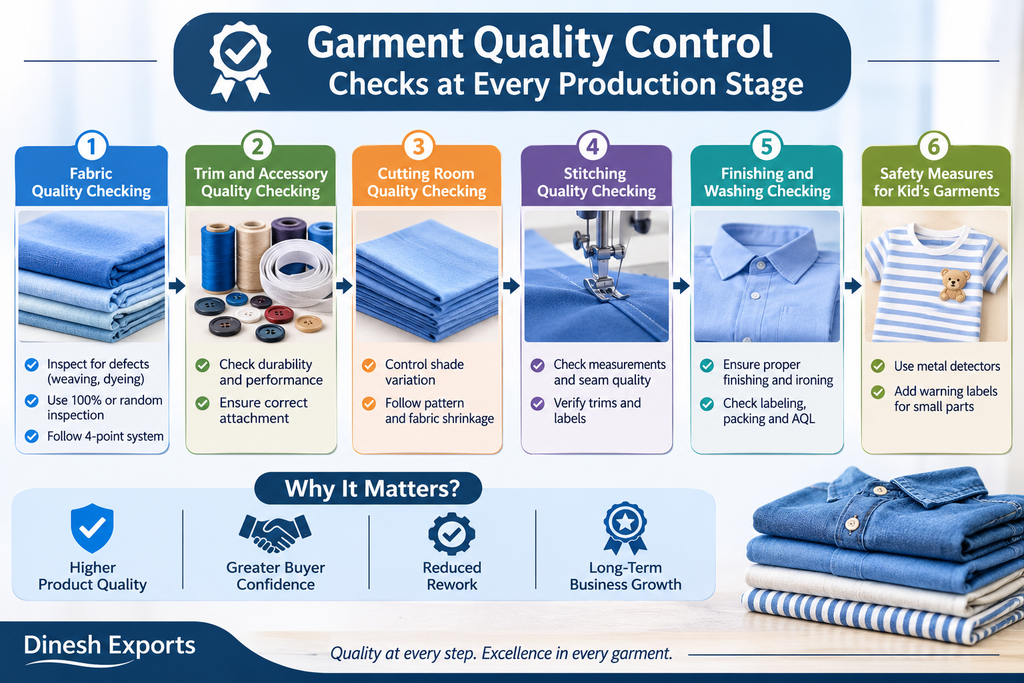
1. Fabric Quality Checking
The fabric is the primary raw material and the most costly item in apparel product manufacturing. A defective fabric will produce a defective garment.
To avoid fabric-related defects in garments, fabrics are inspected prior to cutting. Depending on the quality standards 100% inspection or 10% or random lot inspection is done.
Common defects found in fabrics are – weaving defects, holes, printing/dyeing defects, water crease marks, color variations, etc.
Factories generally follow the 4-point system for fabric inspection for woven as well as knits fabrics.
2. Trim and Accessory Quality Checking
All trims are checked for durability and performance. All trims are attached correctly using proper attachment methods. Ribbon ends are heat-sealed.
Trim materials are checked to perform consistently with the base fabric performance with no differential shrinkage.
3. Cutting Room Quality Checking
Shade variation in cut bundles is being controlled. Other important quality aspects that are taken care of like – using a pattern according to fabric shrinkage, controlling fabric skew or torque, and all plaids, horizontal/vertical stripes are given extra care so as to match the stripes.
4. Stitching Quality Checking
Quality is checked whether garment construction meets the buyer’s requirements like garment measurement, stitching quality, seam quality, and whether trims and labels are attached correctly.
5. Finishing and Washing Quality Checking
All the garments are given sufficient time to relax and dry thoroughly prior to packing to avoid foul smells. Thread cutting, ironing, spotting and other finishing processes are done under strict quality control measures.
At the garment finishing stage, 100% of garments are checked for – correct labeling, hangtag positioning, and carton marking, correct ratio packing, quantity check in each carton as per the packing instruction.
After garment packing, all the packed garments are inspected following AQL by an internal quality inspector. Then shipment is offered to the buyer’s Q.A. team.
6. Safety Measures for Kid’s Garments
To ensure no broken needles or sharp metals remain inside the garment, all kids’ garments are passed through a metal-detecting machine. Secondly, garments with small parts embellishments such as sequins, and beads are labeled with “WARNING…CHOKING HAZARD”.
Accessory items with sharp points and edges are not used on children’s garments. Button pull strength, a sequence as per the buyer’s requirement.
Conclusion
Quality control should be followed at each stage of garment manufacturing from the inspection of the fabric to the final shipment checks. Each department has its own duties and the problems should be detected before the garments go to the next level.
The constant inspection system helps manufacturers to reduce the fabric related defects, improve the quality of stitching and finishing, satisfy the buyer’s requirements and to maintain the safety of the product. Quality control works well when the inspections are done regularly, the standards are clear and the production team and the quality team work well together.
About Dinesh Exports
Dinesh Exports is an Indian woven fabric manufacturer with experience in textile manufacturing since 1994. With its own dyeing and weaving mill in India, the company develops design-driven woven fabrics for men’s, women’s, and children’s clothing.
Our Made in India fabric collections include cotton, yarn-dyed, printed, dobby, seersucker, and other woven fabric options. We work with fashion brands, garment manufacturers, merchandisers, and sourcing teams looking for woven fabrics for different apparel applications.
If you are developing a new clothing collection, explore our digital swatches to review different fabric designs and constructions. Contact Dinesh Exports to discuss your fabric requirements, samples, and pricing. For more information, please contact us.