When you are manufacturing garments for export, fabric quality needs to be checked before it reaches the cutting table. A small difference in GSM, yarn count, shrinkage, color fastness, or fabric construction can create problems later in production.
An in-house textile lab gives an export garment manufacturer a practical way to carry out basic fabric testing before production starts. You may still need third-party laboratories for specialized buyer requirements, but having the basic testing equipment in-house can help identify common problems early.
Why Set Up an In-House Textile Lab?
It is really a good idea to set up an in-house textile lab for checking basic physical properties of textiles. Why depend on Third Party testing labs for the confirmation of specification like fabric count, yarn count, and color matching?
Fabric properties like dimensional stability, color bleeding, and color fastness to washing can’t be ignored. The buyer would not accept any goods failing these basic requirements. As an export garment manufacturer don’t start cutting fabric for production without testing above mentioned fabric properties.
It is also true that an export house can’t keep all types of machinery required to test buyer test specifications. It is not feasible though. The primary test required for physical properties and machine required to do those tests for the in-house testing lab set up have been enlisted in the following table.
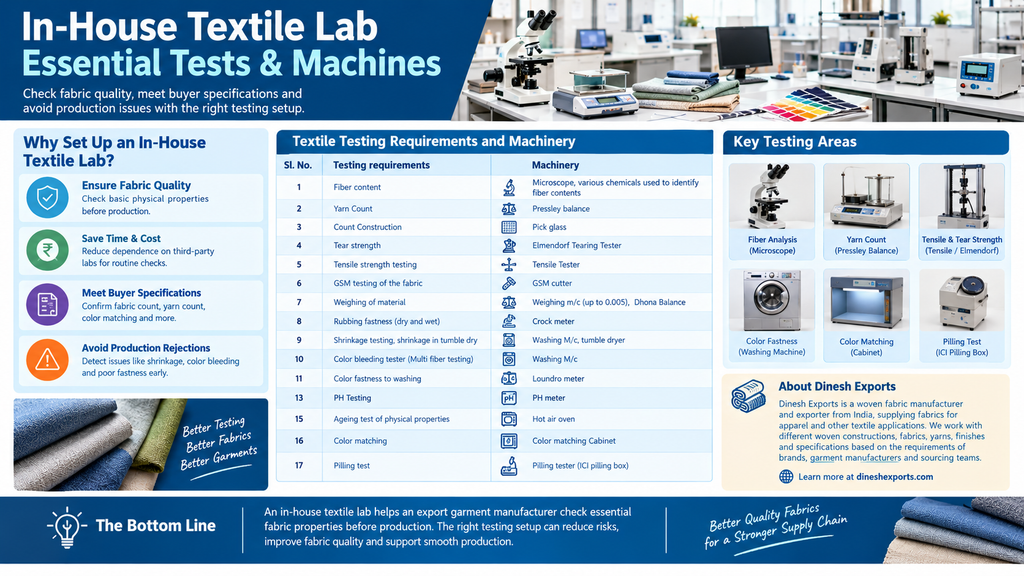
Textile Testing Requirements and Machinery
| Sl. No. | Testing requirements | Machinery |
| 1 | Fiber content | Microscope, various chemicals used to identify fiber contents |
| 2 | Yarn Count | Pressley balance |
| 3 | Count Construction | Pick glass |
| 4 | Tear strength | Elmendorf Tearing Tester |
| 5 | Tensile strength testing | Tensile Tester |
| 6 | GSM testing of the fabric | GSM cutter |
| 7 | Weighing of material | Weighing m/c (up to 0.005), Dhona Balance |
| 8 | Rubbing fastness (dry and wet) | Crock meter |
| 9 | Shrinkage testing, shrinkage in tumble dry | Washing M/c, tumble dryer |
| 10 | Color bleeding tester (Multi fiber testing) | Washing M/c |
| 11 | Color fastness to washing | Loundro meter |
| 13 | PH Testing | PH meter |
| 15 | Ageing test of physical properties | Hot air oven |
| 16 | Color matching | Color matching Cabinet |
| 17 | Pilling test | Pilling tester (ICI pilling box) |
Related Resources
If you work with fabric specifications, testing, and sourcing, these Dinesh Exports articles can also help:
- Fabric GSM: Small Number Affecting Fabric Manufacturing
Read the article - Textile Chemicals Explained for Fabric Buyers
Read the article - Types of Woven Fabric Explained: Plain, Twill, Satin & More
Read the article - Cotton Woven Fabric: Benefits, Types & Why It’s a Timeless Choice
Read the article - Woven Fabric: Everything You Need to Know
Read the article - A Beginner’s Guide to Woven Fabrics
Read the article
About Dinesh Exports
Dinesh Exports is a woven fabric manufacturer and exporter from India, supplying fabrics for apparel and other textile applications. We work with different woven constructions, fabrics, yarns, finishes, and specifications based on the requirements of brands, garment manufacturers, and sourcing teams.
Quality and consistency matter throughout fabric manufacturing, from yarn and weaving to dyeing, finishing, inspection, and final fabric supply. Our focus is on helping buyers source woven fabrics that meet their required specifications and production needs. Contact us here.
Conclusion
An in-house textile lab does not have to replace every specialized third-party testing facility. For an export garment manufacturer, the practical goal is to have the equipment needed to check basic fabric properties before production.
Testing parameters such as fabric count, yarn count, GSM, shrinkage, tensile strength, tear strength, color fastness, pH, color matching, and pilling can help identify problems before fabric moves into garment production. A basic in-house testing setup can therefore become an important part of maintaining fabric quality and reducing avoidable production issues.