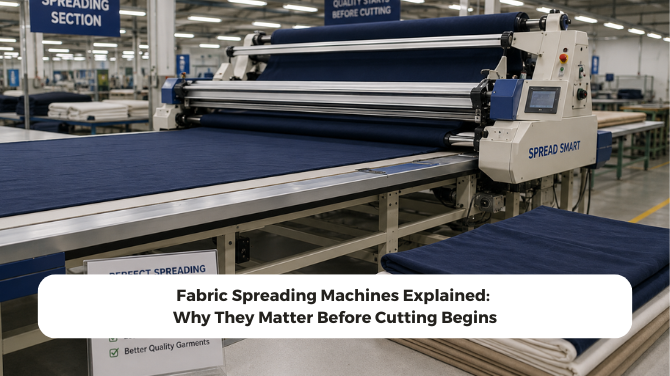
In garment production, fabric spreading is the first step taken, even before the cutting takes place. The fabric needs to be properly spread so that the cutting can take place without anything going wrong and messing up your fabrics. An important step like this requires a machine to get the job done; this is where a fabric spreading machine comes into play. Before spreading the woven fabrics, understanding the characteristics is equally important.
Check out our digital fabric swatch here
What Is A Fabric Spreading Machine?
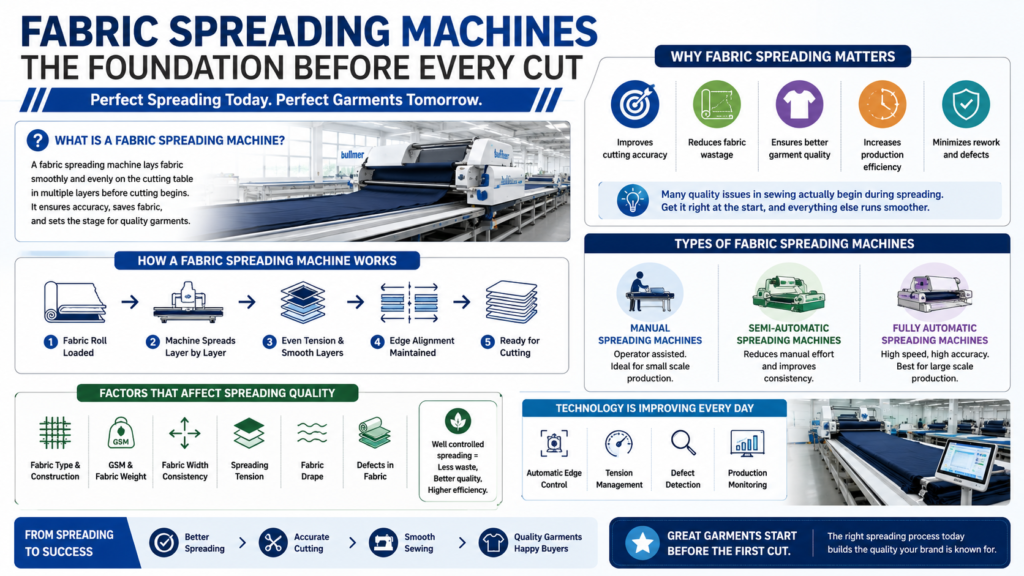
A fabric spreading machine is a type of equipment used for laying layers of fabric on a cutting table in a perfect manner.
It’s a simple task to be done, but doing it manually can cause the layers to wrinkle and the cuts to become imperfect.
The machine will place the fabric flat on the table with proper tension, align the edges, and build the required number of layers on the cutting table. All without human intervention. This is why many manufacturers choose a fabric spreading machine if they want to scale their output.
Why Fabric Spreading Matters So Much
The accuracy of the garment heavily depends on the cut pieces. This is the reason why we need to get the spreading perfect. Imagine if the fabric stretches a bit too much while spreading. These pieces will shrink back after cutting. In our recent article on cotton yarn, we discussed how yarn quality directly affects fabric performance.
In other cases, if the fabric layers are uneven, the garment panels may not even match correctly during the sewing phase.
If these mistakes happen, then the garment manufacturer will incur a lot of losses, in money and other resources. Even losing their clients, for some. In order to avoid all these issues beforehand and maintain high quality control, experienced garment manufacturers will pay close attention to the cutting process and the implementation of a fabric spreading machine at their factory or unit.
How A Fabric Spreading Machine Works
The way a fabric spreading machine works is by traveling along the cutting table while layering the fabric one on top of the other. How the fabric is spread is based on the requirements of the garment.
For example, the machine can layer fabric in different ways, like all layers facing up or fabrics facing each other. Some machines can also be programmed to layer in different ways based on the construction and garment design.
In all these cases, the goal of the machine remains the same: to evenly layer the fabrics to avoid any mistakes after cutting. Different weave structures will behave differently during spreading, we discussed how various types of woven fabric weave structure affects its performance and behavior.
Manual Spreading Vs Machine Spreading
There are factories in India that use manual spreading. It is a highly time-consuming process, and mostly it is done by experienced professionals with a high number of cutting experiences under their belt.
These cutting professionals will carefully layer the fabrics and then go on to cut them. While this is still true, there are thousands of units that use a machine to spread. Their output is much higher than that of a manual cutting unit.
A machine will not make any mistakes in general; it will layer it according to requirement, following all the rules like tension, alignment, etc.
3 Different Types Of Fabric Spreading Machines
There are a lot of companies making fabric spreading machines. And each of them is different and used for various use cases. Here are the 3 common types of fabric spreading machines:
- Manual Fabric Spreading Machines
Manual spreading machines are usually used in small-scale production units. It requires an operator’s assistance while spreading the fabrics. The output is relatively low in these units.
- Semi-Automatic Spreading Machines
Semi-automatic spreading machines will lower the dependence on the operator’s assistance while doing their job. It will still require oversight, as it may need some human input from time to time. These are used in medium-sized garment factories.
- Fully Automatic Fabric Spreading Machines
If you are looking for a spreading machine with high output, speed, efficiency, and no human oversight, then this is for you. These are used mostly in large-scale manufacturing units. Large volume exports orders and other large brands use them.
In garment production, production efficiency matters the most, and optimizing the strategies to reduce garment sampling development time in crucial.
Fabric Type Also Influences The Spreading Process
Fabrics behave differently based on the fabric composition and how it’s made. Lightweight fabrics require a different type of handling compared to heavier constructions. If there is elastane in the fabric, then it also seeks additional attention while spreading it.
For example, a lightweight linen blend fabric needs to be handled differently from that of a satin or cotton elastane blend fabric.
On another note, fabrics with different GSM levels require different spreading controls as well. We discussed fabric weight in detail in our recent article fabric GSM, feel free to check it out to learn more.
This is the reason why spreading settings are often changed depending on the type of fabric being processed.
Why Proper Spreading Reduces Fabric Waste
In garment manufacturing, the highest cost is often the fabric itself. If your spreading process is done perfectly, with 100 accuracy, then the chances of messing up the process are low. Things like:
- Misalignment
- Wrinkles
- Tension issues
- Uneven layers
It can be avoided, saving resources for the unit.
Measurement variations can appear if the layers on the cutting table are uneven or shift during the cutting process.
This will lead to fitting problems and quality failures during inspection.
We discussed a similar topic in our recent article on TLS in the garment industry, where identifying issues early in the production process can help prevent larger quality problems later on, feel free to check it out.
Technology Is Changing Fabric Spreading
Innovations are always happening in the textile and garment manufacturing space. Day by day, new machines are appearing in the market that have features like:
- Automatic edge control
- Tension management
- Defect detection
- Production monitoring
As we are going towards a more automated production process, we can expect more and more technologies to improve, specifically in the fabric spreading space. Reducing waste through better fabric spreading techniques also supports sustainability goals. You can learn more about this in our recent article on sustainable fabrics.
Working With Quality-Focused Manufacturing Partners
At Dinesh Exports, we have been providing woven fabrics of all types for more than three decades across plain weave, twill weave, jacquard fabric, Dobby fabric, yarn dyed fabrics, linen blend fabrics, and all types of sustainable fabrics.
We have more than 200 employees working towards achieving the goals for our clients, from product development to shipping. We also ensure that our clients get the right after-sales services. If you’d like to learn more about us, feel free to contact us here.
Final Thoughts
A fabric spreading machine is an important part of the garment manufacturing process, as it plays an important role in controlling the quality of the finished goods.
If you have access to a proper fabric spreading machine, it will allow you to control the cutting accuracy, reduce fabric waste, and help maintain garment consistency throughout production.
While most manufacturers emphasise only the cutting process, experienced manufacturers know the importance of fabric spreading, and they constantly invest more in something like fabric spreading machines.
Frequently Asked Questions
What is a fabric spreading machine?
It is a type of equipment that lays fabric on top of each other, preparing it for cutting.
Why is fabric spreading important?
Because it will improve cutting accuracy, reduce waste, and help maintain overall garment quality.
Can fabric spreading affect garment quality?
Yes, it can reduce garment quality as wrong spreading will affect the tension and the shape of the cuts.
Are spreading machines used in all garment factories?
Depending on the production capabilities of a garment manufacturing unit, they will use either manual fabric spreading or a machine.