Manpower is one of the highest operating costs in garment manufacturing, but reducing headcount should not be the first solution. A better approach is to understand where workers are being underutilized, measure the actual work required, improve skills, and use machines or better methods where they make sense.
This article looks at practical ways to reduce excess manpower in a garment factory while making better use of the workers, machines, and production capacity already available.
Why Manpower Utilization Matters
To become competitive and increase profit in a manufacturing business, resources like manpower should be utilized as much as possible. In business terms, extra manpower means extra cost to the company. In such situations, management must find a way for cost-cutting through manpower reduction wherever possible. The steps to take for reducing manpower are explained here.
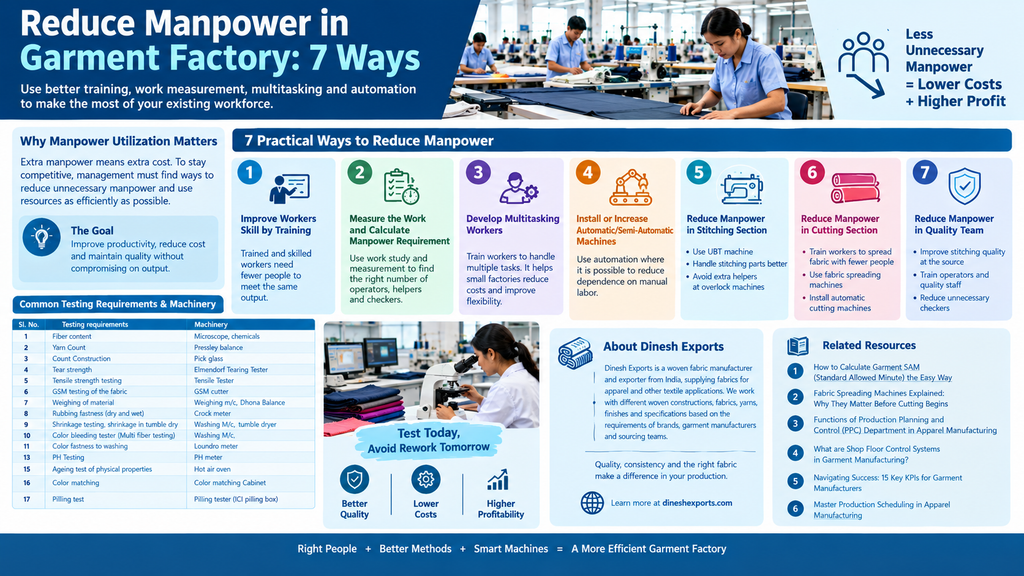
1. Improve Workers’ Skills by Training
When you have low-skilled operators (workers) in your factory, normally you need to employ more people to produce the planned quantity. A systematic training program for workers that increases individual workers’ skills will increase your capacity. Eventually, the need of workers will be reduced.
2. Measure the Work and Calculate Manpower Requirement Accordingly
Do you know exactly how much manpower (operators, helpers, and checkers) is enough to produce the same production that you are getting right now? It is not possible to estimate the number without work study and work measurement. So first you need to measure work and calculate actual manpower requirement and employ accordingly.
3. Develop Multitasking Workers/Employees as Much as Possible
Through training, you can increase the number of multitasking operators. In small factories, multitasking workers are very useful in terms of cost saving.
4. Install or Increase Automatic/Semi-Automatic Machines
You might have an automatic workstation for some activities. You can further increase the number of automatic workstations wherever applicable.
Remember one thing – don’t fire employees/workers for cost cutting. Instead, involve unutilized workers in other activities (in other departments) or improve factory capacity to utilize all manpower resources.
Reduction of Manpower in Stitching Section
Use of UBT machine: Thread trimming from each lock stitch operation can be done by using an auto thread trimmer (UBT machine).
Handling stitching parts: You can place one trolley or basket parts in the front of the machine for disposing stitched garments or garment. Why do operators need someone to stand there and pick each stitched piece and bundle it? If the operation needs bundling, the same operator should do that job.
Cutting stitching chains: I would say it is really a luxury in work by allocating extra manpower (helper) at the overlock machine; those are overlocking small components, and stitched parts are coming out from the machine in a chain.
Reduction of Manpower in Cutting Section
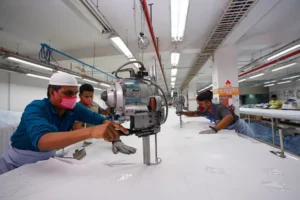
In the cutting section, I have seen helpers stand on both sides of the cutting table, and they align fabric edges on the lay (see the above image). They help in spreading the plies.
Solution: You can train cutting room workers on how to spread layers with two persons (max 4 persons).
Secondly, you can use an automatic or semi-automatic fabric spreading machine (for fabric rolls). Yes, installation of such a machine needs some investment. I would say automatic spreading machines are cost-effective if you have high production volume. Additionally, you can also improve cutting room production by installing an automatic cutting machine.
Reduction of Manpower in Quality Team
Do you believe that by checking garments you can improve stitching quality of your products? No. That is not possible. Garment quality (stitch quality) is made at the sewing needle and is made by the sewing operator. Checkers just segregate good and defective garments. By improving quality awareness among sewing operators and other workers on the floor, and providing training to checkers and the quality team, you can improve effectiveness in quality checking. This way you may reduce need of checkers to some extent.
These are some of ideas that can be followed to reduce extra manpower in a garment factory. What do you think about these ideas?
Related Resources
Here are some Dinesh Exports articles that can help garment manufacturers look at manpower utilization, work measurement, automation, cutting efficiency, and production control from different angles:
- How to Calculate Garment SAM (Standard Allowed Minute) the Easy Way
Read the article
SAM is useful when calculating labor requirements, production capacity, and efficiency. - Fabric Spreading Machines Explained: Why They Matter Before Cutting Begins
Read the article
This article looks at manual, semi-automatic, and fully automatic fabric spreading and how machines can reduce dependence on manual work. - Functions of Production Planning and Control (PPC) Department in Apparel Manufacturing
Read the article
PPC covers resource allocation, manpower scheduling, machine loading, production control, and efficiency optimization. - What are Shop Floor Control Systems in Garment Manufacturing?
Read the article
Learn how shop-floor systems can help with workforce allocation, machine utilization, production monitoring, and resource utilization. - Navigating Success: 15 Key KPIs for Garment Manufacturers
Read the article
The article includes employee productivity, machine downtime, lead time, reject rate, and other useful manufacturing KPIs. - Master Production Scheduling in Apparel Manufacturing
Read the article
MPS connects production demand with available manpower, machine capacity, line efficiency, and delivery requirements.
About Dinesh Exports
At Dinesh Exports, we understand that fabric, production planning, manpower, and machine capacity all need to work together for smooth garment manufacturing. We are a woven fabric manufacturer and exporter from India, supplying fabrics for apparel brands, garment manufacturers, sourcing teams, and other textile businesses.
Our experience across woven fabrics and textile manufacturing gives us a practical understanding of the production requirements that garment manufacturers deal with every day. From fabric selection and GSM to production planning and cutting, the right material and the right process both matter when you are trying to improve efficiency. Please contact us to learn more.
Conclusion
Reducing manpower does not always mean reducing the number of employees. In many factories, the better opportunity is to remove unnecessary tasks, improve worker skills, measure actual manpower requirements, develop multitasking workers, and introduce automation where it makes commercial sense.
A factory can often achieve better productivity by improving the way existing manpower is used. The goal should be to reduce idle time and unnecessary work while giving workers more productive responsibilities and improving overall factory capacity.