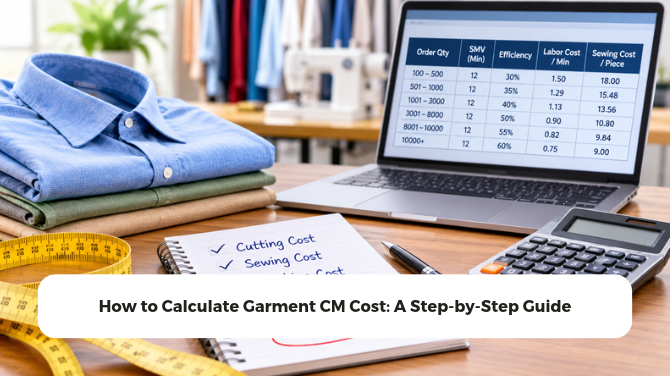
Calculation of Cost of Making (CM) is very important to be able to do garment costing and order booking. Buyers and manufacturers require an accurate estimate before placing an order, but it is difficult to arrive at the right figure without good labor cost and production data.
Keeping up-to-date records of cutting and finishing costs, sewing labor rates, average style efficiency and garment SMV is one practical way. This guide describes how to use these figures to estimate the CM cost of a garment at the early stages of product development.
How to Calculate Product CM Cost
CM is referred to fabric cutting and garment sewing (making) labor cost per unit. Actually, all labor costs like cutting, sewing, pressing, folding and packing are included into CM. If one asked you what would be the CM of a product, you may find it is very difficult to answer with correct figure due to complexity in calculation. But if you follow logical method and keep your database ready and updated you can determine CM of a product with no time. Preparation of a database is onetime job and you need to update regularly or when updating is required.
Following steps will help you to determine product CM cost. Sewing process has much variation in terms of work contents (time required to make a garment) than cutting and finishing process. So for cutting and finishing process there is less variation in labor cost per unit.
Step 1: Make database for labor cost per pieces for cutting and finishing
Just get last six months labor wages for cutting and finishing departments (excluding staffs) and total units cut and finished in lat six months. Calculate labor cost per pieces for cutting and finishing department.
Cutting labor cost per piece = Total salary paid to cutting labors in a time period / Total pieces cut in that time period
Finishing labor cost per piece = Total salary paid to finishing labors in a time period / Total pieces packed in that time period.
If you want accuracy in cutting and finishing cost then calculate product wise labor cost per piece.
Step 2: Determine sewing labor cost per minute
Per minute cost of a factory depends on line efficiency. And average line efficiency of a style depends on style run (order quantity). First thing first, to calculate sewing labor cost create database for average style efficiency according to order quantity. See Table-1 for example. This database needs to be updated regularly. To calculate efficiency of a style use following formula –
= (Order qty. * Garment SMV * 100) / (Total man hours spent to complete the style * 60)
Instead of quantity you can use actual total production quantity in the style.
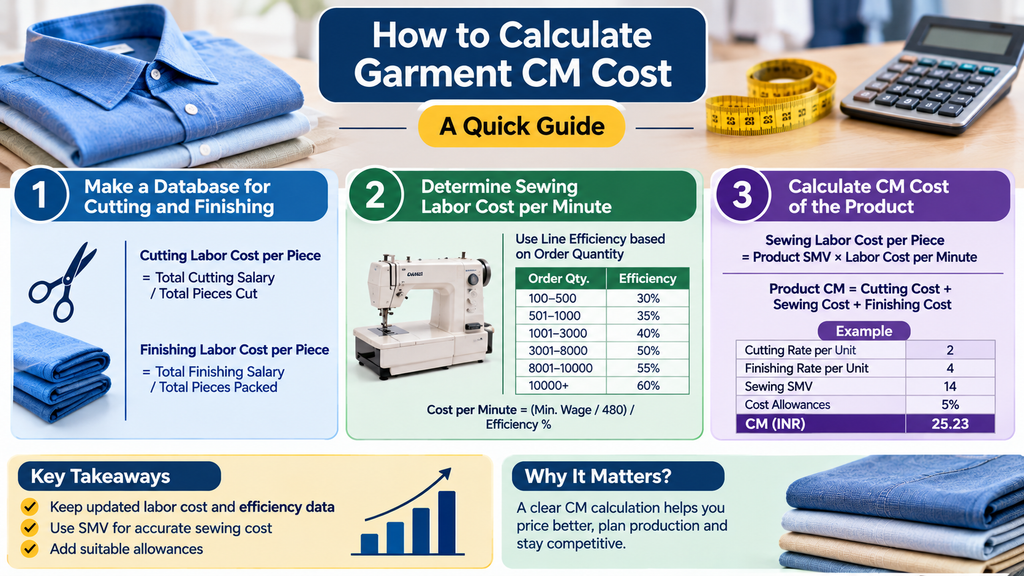
Table-1: Line efficiency at different order quantity
| Order qty. | Average style Efficiency |
| 100-500 | 30% |
| 501-1000 | 35% |
| 1001-3000 | 40% |
| 3001-8000 | 50% |
| 8001-10000 | 55% |
| 10000 plus | 60% |
Once you have average efficiency based on order quantity calculate sewing labor cost per minute. Collect updated list of minimum wages for skilled labor or get average employee rates from Human Resource (HR) department.
Cost per minutes = (Minimum wages of high skilled labor / 480)/Efficiency%
See following Table-2, where it shows style efficiency is 55%, minimum daily wages (for high skilled operator) INR 340 and work shift time 8 hours (480 minutes). So, cost per minutes is INR 1.29
Table -2: Factors to calculate sewing labor cost per minutes
| Order qty | Minimum wages (high skilled) | Minutes/day | Efficiency level | Labor Cost/minutes |
| 8001-10000 | 340 | 480 | 55% | 1.29 |
Step-3: Calculate CM cost of the product
SMV is one very important component for product cost calculation. For the correct SMV of a product, consult with industrial engineering department. Or create your database for product SMV with style variations. Once you get product SMV add certain percentage on it as buffer.
Sewing labor cost per piece = Product SMV X labor cost per minute (@ predefined efficiency)
Product CM = (Cutting cost + Sewing cost +Finishing cost)
For safety, add allowances on the calculated CM prior to offering cost to your buyer.
| Cutting rate per unit | Finishing rate per unit | Sewing SMV | Cost allowances | CM (INR) |
| 2 | 4 | 14 | 5% | 25.23 |
In the above example, cutting cost is INR 2, finishing cost INR 4 and sewing SMV taken 14 minutes. Later, 5% allowances are added to the calculated cost to reach to final CM cost.
Conclusion
If a factory keeps updated on labor cost, style efficiency and garment SMV, then garment CM cost can be easily calculated. This allows the manufacturers to make a useful estimate before taking on an order by breaking down costs for cutting, sewing and finishing.
The calculated CM should also include adequate cost allowances. The database is periodically reviewed and updated to ensure the estimates remain relevant as wages, production efficiency and operating conditions change.
About Dinesh Exports
Dinesh Exports is an Indian woven fabric manufacturer that has been involved in the manufacture of fabric, dyeing and weaving since 1994. We design and manufacture woven fabrics for men’s, women’s and children’s wear, working with fashion brands and retailers, garment manufacturers and sourcing teams.
Our Made in India fabric collections comprise a variety of woven constructions, designs and finishes. We know that fabric choice and precise material planning are vital to garment development and costing. If you need more information, please contact us.
Related Resources
- Understanding the Cost of Manufacturing Apparel
- How to Calculate Garment SAM (Standard Allowed Minute) the Easy Way
- Monthly Garment Line Efficiency Calculation
- Line Efficiency for Multiple Styles: Easy Guide
- Merchandisers Guide to Bill of Material (BOM)
- How to Calculate Fabric Consumption of a Garment?