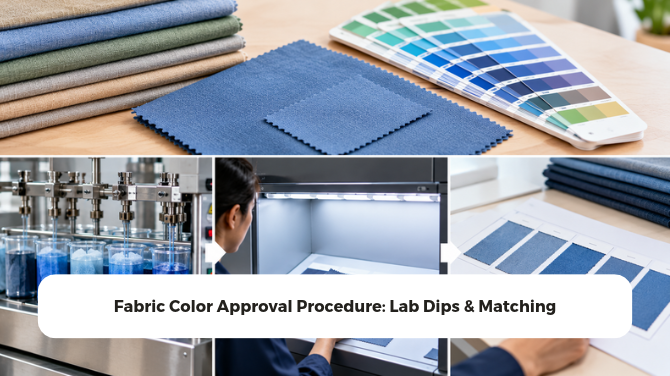
Fabric color approval is an important step in textile product development. Before bulk fabric dyeing begins, the customer and supplier need to agree on the required shade and establish an acceptable level of color variation. Understanding the fabric color approval procedure, from defining color standards to approving lab dips and checking production shades, helps buyers and suppliers reduce shade-related issues during bulk production.
Download our digital fabric swatch here
Fabric Color Approval Procedure
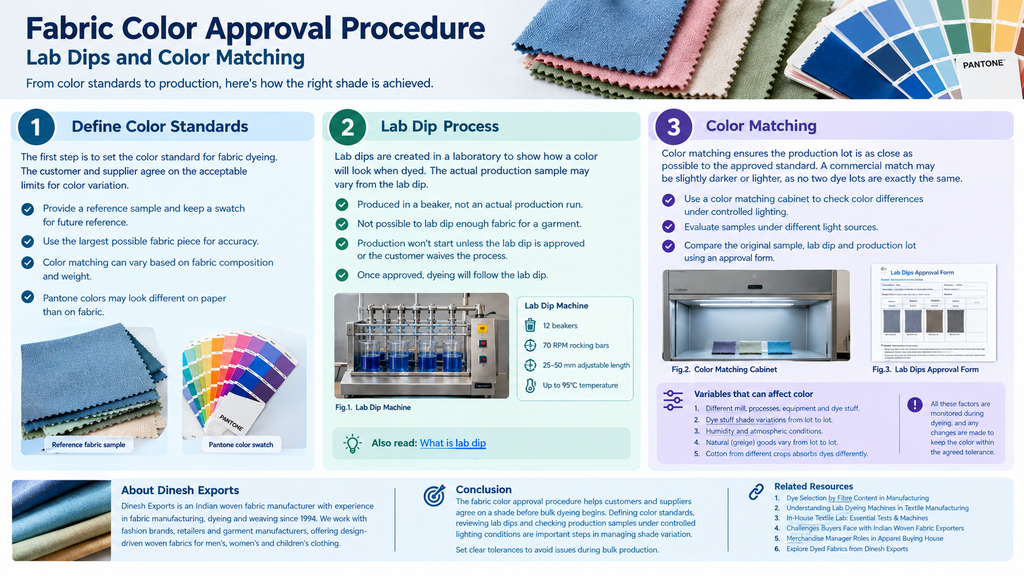
In the process of product development, the customer and supplier need to define the material (fabric) color for the product that needs to be produced. The fabric color approval procedure and shade matching procedure are explained in this post. There are several phases in completing this procedure like,
- Define Color Standards
- Lab dip process
- Color matching
1. Define Color Standards
The first step is to define the color standards for the fabric dyeing, which should be used as a frame for the future production. This means that the customer and supplier will set acceptable limits for the color variations. The customer must provide a reference sample to the supplier of the color requested and keep a sample swatch for their future reference.
The piece provided to supplier needs to be as big as possible so it will be easier for the supplier to hit the right color. The color matching will be different if the composition or weight of the provided fabric is different. Please notice that in case of using a Pantone Color Swatch, the printed colors on the paper will look different than on a fabric texture.
2. Lab Dip Process
Fig.1. Lab Dip Machine.
After defining the fabric color, the next step is making a Lab Dip sample. Lab dips are done in the laboratory environment with purpose to provide a visual aid on how a color will look when it is dyed. The actual production sample will vary from the lab dip that is provided. Remember that the lab dip is produced in a beaker and is not an actual production run.
It is not possible to lab dip enough fabric for a sample cap or garment. When the goods are dyed in a real production run, the conditions are dramatically different from the laboratory. Production of the fabric will not begin unless a lab dip is approved or the customer waives the lab dip processes. Once a lab dip is approved the dyeing will start only according to the approved lab dip. Lab Dip machine is presented on Fig.1.
Also read: What is lab dip
The machine can be used for dyeing of fabric, yarn and loose stock samples. Rocking bars apart from up to down motion rotate at 70 RPM and their length can be adjusted between 25mm to 50mm. The number of beakers is 12 with up to 95C possible dyeing temperature.
3. Color Matching
Color matching in an important part of fabric color approval procedure. The supplier should make an effort to get the special dye lot as close to the color standard/lab dip as possible. But, no two dye lots are the exact same color. However, a commercial match to customer’s color will be achieved on a special dye lot. A commercial match will be a similar tone that may be slightly darker or lighter than the color standard.
A fabric color matching cabinet machine presented on the Fig. 2 can be used for detection of color difference between the production lot sample and the standard one. The usage of this machine is for the visual assessment of color under standardized and controlled environment. It allows a person to evaluate color samples under different light sources.
Fig.2: Color cabinet for fabric color matching
The machine provides –
- Artificial Daylight Fluorescent Lamps (D-65)
- Tungsten Filament Lamps
- Tri Phosphor Fluorescent Lamps (TL84)
- Ultra violet Black Lamp (UVB)
- Cool White Fluorescent Lamp (CWF)
- Hour Meter.
When the supplier starts the lot dyeing, he needs to provide a lot sample to the customer for approval. The form presented in Fig.3 can be used to compare the original watch sample with lab dip samples and select the one that is acceptable for the future production.
Fig.3 Lab dips approval form
There are many variables that can influence in a variation of the color or appearance which make it impossible to get an exact match. Some of these variables include:
- The color swatch was produced from a different mill with different processes, equipment and dye stuff.
- Dye stuffs used to produce fabric vary in shade from lot to lot.
- Atmospheric conditions such as humidity vary day to day.
- The natural (greige) goods vary from lot to lot. Some woven goods are very clean and the dyes absorb deeply while others may not take as deep.
- The cotton from different crops will absorb dyes differently.
During the dying process, all of these variables must be constantly monitored and changes are made to keep the color as close to the color standard as possible. Even while making these changes, there will be a slight variance in shade from the reference sample to the lab dip, to the actual production run. All these variances should be in the acceptable tolerance that was arranged in advance between the customer and supplier.
Conclusion
The fabric color approval procedure helps customers and suppliers agree on a shade before bulk dyeing begins. Defining color standards, reviewing lab dips, and checking production samples under controlled lighting conditions are important steps in managing shade variation. Since an exact match between laboratory samples and bulk production may not always be possible, both parties should agree on acceptable color tolerances before production starts.
About Dinesh Exports
Dinesh Exports is an Indian woven fabric manufacturer with experience in fabric manufacturing, dyeing, and weaving. Since 1994, we have worked with fabrics for men’s, women’s, and children’s clothing, with a focus on design-driven woven fabrics and quality consistency. Our Made in India fabric collections include a range of constructions, colors, and designs for fashion brands, retailers, and garment manufacturers.
For buyers sourcing woven fabrics, clear color standards and timely sample approvals are important parts of moving from product development to bulk production. Please contact us for more information.
Related Resources
- Dye Selection by Fibre Content in Manufacturing
- Understanding Lab Dyeing Machines in Textile Manufacturing
- In-House Textile Lab: Essential Tests & Machines
- Challenges Buyers Face with Indian Woven Fabric Exporters
- Merchandise Manager Roles in Apparel Buying House
- Explore Dyed Fabrics from Dinesh Exports