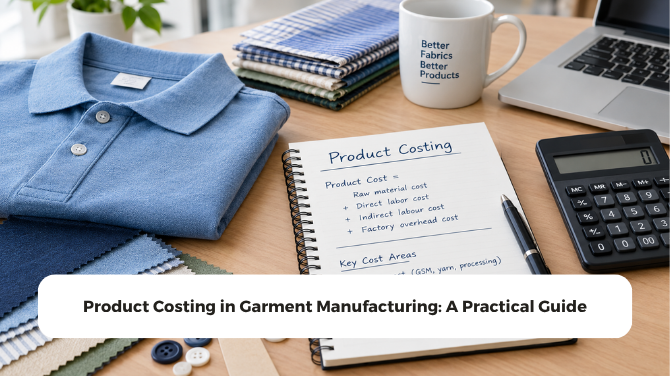
Product costing is an important part of apparel manufacturing because it helps businesses understand how much it costs to make a garment before deciding its selling price. For merchandisers, garment manufacturers, and sourcing teams, accurate costing means accounting for fabric, trims, labour, processing, and factory overheads.
Even a small error in fabric consumption or process costs can affect the profitability of a bulk order. This guide explains the main components of product costing in garment manufacturing, with formulas and a practical fabric-costing example.
Product Costing
Product costing and product pricing is an essential part of a business. To estimate the cost of a product you need to develop skill on this by learning product costing method, and product manufacturing processes. This post is related to apparel manufacturing. Here you will find steps to prepare to cost for apparel products.
This is a useful article for apparel merchandiser and others, who is involved in garment costing. This article shows how to calculate material and process cost for a knitted polo shirt.
Product Costing
The simplest way to find the product cost
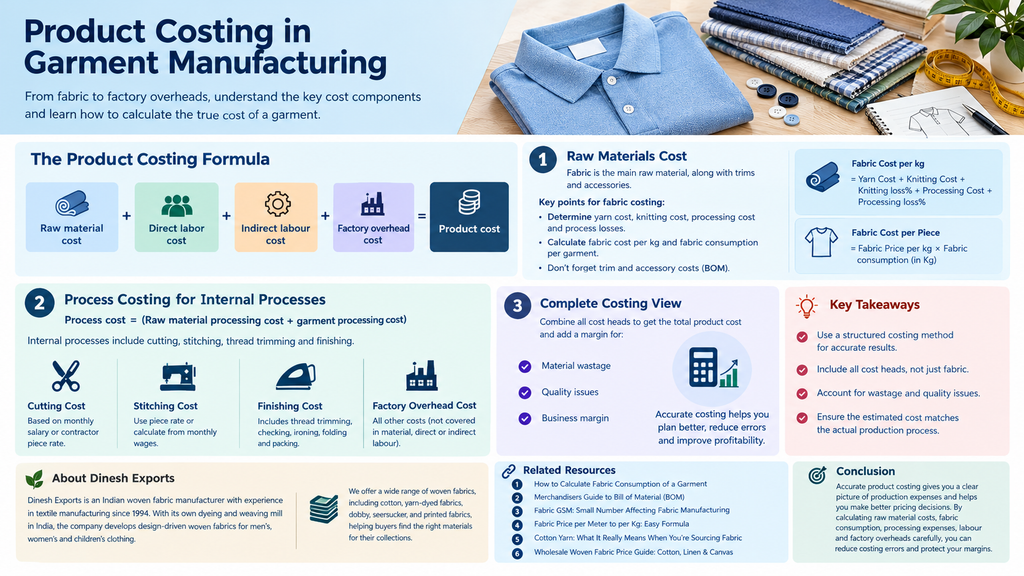
Product Cost = Raw material cost + direct labor cost + indirect labour cost + factory overhead cost
To estimate product cost you need to know or calculate all the above cost heads separately.
1. Raw Materials Cost
Let first discuss raw material costing. Fabric is the main raw material for a garment and other raw materials include various trims and accessories.
1.1 Fabric Costing:
The costing of knitted fabrics is done according to weight i.e. GSM. Before GSM can be calculated, it is important to know the yarn cost, knitting cost, processing costs and the process losses. First you need to collect fabric/yarn price and process costs from your vendors and processors for your internal costing purpose. For example suppose you have following details of yarn price and other process
Yarn Price: In case you are planning to source yarns and knit the fabric by yourself or from knitters, you have to collect yarn price for the yarn you will be using in your fabric. These are few different yarns types – 20s, 30s, 50s, 2/60s Combed. In case you need dyed yarn for stripe fabric collect price for dyed yarns.
Knitting Price: There are different types of knits fabrics, like Single Jersey, Rib, Interlock, Feeder stripes, jacquard fabrics. Prices for making such fabrics are different. You need to know their price and use the price in costing. Also consider knitting loss% while calculating yarn requirement and yarn costing. Normally 2% is taken as knitting process loss calculation.
Do you need to dye your fabric for colored fabric? If yes, contact with dyeing house/mill and collect dyeing price. Add process loss% for dyeing. If you need other kind of finishing checks those finishing prices (Fabric stage).
So, you get fabric price using following formula:
Cost per kg for shell fabric = Yarn Cost + Knitting Cost + Knitting loss% + Processing Cost + Processing loss%
Cost per kg of collar/cuff fabric – = Yarn Cost +Knitting Cost + Knitting loss% + Processing Cost + Processing loss%
In a style, there might be more than one type of fabric used. You need to find fabric cost (processing cost) all fabrics separately.
Fabric Consumption per garment:
Find fabric consumption per garment considering average garment size and making a few sample garments. Read the method of calculating fabric consumption. Once you have the fabric price and fabric consumption you can easily calculate the cost of fabric per garment using the following formula,
Fabric Cost/Piece = Fabric Price per kg * Fabric consumption (in Kg).
This is explained with one simple example. Price of the fabric that you need for your order is Rs. 400 per kg and consumption of fabric per garment 230 grams (0.23 kg) including wastage. Then cost of fabric per garment would be Rs. (0.23 * 400) i.e. Rs. 92.
For woven product, you will get fabric price per meters. You have to find fabric consumption in meters and use same formula to find fabric cost.
1.2 Trim and accessory cost
Prepare bill of material for the given order and calculate trims cost per garment. In the bill of material per piece, material cost is calculated. Fabric details are also included in the Bill of material.
So, to find process cost first you need to know complete processes to be followed for the given order. If you are sourcing yarns and knit it by yourself read further.
2. Process Costing for internal processes
Process cost = (Raw material processing cost + garment processing cost)
Garment factories stitched garments in-house and source raw materials such as fabrics, trims and accessories. Some garment factories prefer buying yarns instead of purchasing finished fabric. Raw material process costing is already discussed above.
Internal processes for direct labour cost and indirect cost are fabric cutting, stitching, thread trimming and finishing.
Cutting cost: Per piece cutting cost is derived from monthly salary of the cutting team. In case cutting is done by contractors, piece rate is taken for cutting cost.
Stitching cost: If factory pays piece rate to operators then take piece rate, or calculate direct stitching labour cost from the monthly wages.
Finishing Cost: Finishing process includes thread trimming, checking, ironing, folding, and packing. You can calculate process wise cost and sum up those to find finishing cost. Or you can take monthly wages (average) in the finishing section and divide it by total production to get per piece cost for finishing process.
Factory overhead costing: In factory overhead cost all costs other than material cost and direct and indirect labour are included (if you have not calculating expenses in other cost heads).
Conclusion:
In the above I have just covered things you need to know and cost that you need to include in product costing. There are various method costing apparel product and later calculate its pricing. The aim is to know exact cost of making the product. Actual product cost should not less than the estimated cost.
Remember to add some margin in all these cost as buffer and material wastage and find quality issue in garment production. You can use same method for costing any other apparel products in knits and woven product.
About Dinesh Exports
Dinesh Exports is an Indian woven fabric manufacturer with experience in textile manufacturing since 1994. With its own dyeing and weaving mill in India, the company develops design-driven woven fabrics for men’s, women’s, and children’s clothing.
For apparel brands, garment manufacturers, merchandisers, and sourcing teams, selecting the right fabric is an important part of product development and cost planning. Dinesh Exports offers a range of woven fabrics, including cotton, yarn-dyed fabrics, dobby, seersucker, and printed fabrics, helping buyers explore suitable materials for their collections.
If you are developing a new garment range, you can explore our fabric collections and digital swatches to review fabric options before moving ahead with sampling and bulk production. For more information, please contact us.
Related Resources
- How to Calculate Fabric Consumption of a Garment
- Merchandisers Guide to Bill of Material (BOM)
- Fabric GSM: Small Number Affecting Fabric Manufacturing
- Fabric Price per Meter to per Kg: Easy Formula
- Cotton Yarn: What It Really Means When You’re Sourcing Fabric
- Wholesale Woven Fabric Price Guide: Cotton, Linen & Canvas
Final Thoughts
Accurate product costing gives apparel businesses a clearer picture of production expenses and helps them make better pricing decisions. By calculating raw material costs, fabric consumption, processing expenses, labour, and factory overheads carefully, manufacturers and merchandisers can reduce costing errors and protect their margins.
Before finalizing a garment price, review the cost assumptions, account for expected wastage, and check whether the estimated cost reflects the actual production process. A reliable costing method helps businesses plan orders with greater confidence.