One of the first questions buyers ask is a simple one, and that is “What is the price per meter?” It’s a straightforward question, but the pricing rarely works that way, simply. You may see two identical fabrics; they may look entirely the same, but their costing could be entirely different, and it depends on the yarn quality, construction, finishing, and certifications.
Check out our digital swatch here
Why Fabric Prices Vary So Much
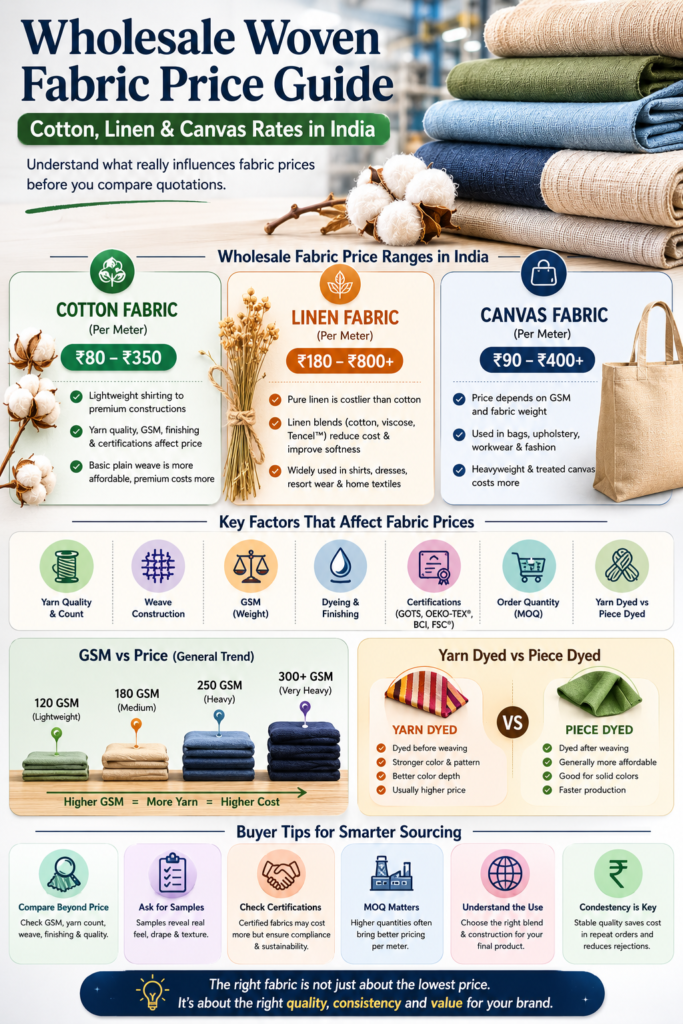
There is a misconception among common people that the fiber is the only factor that affects the price. But it is only a single part of the picture. What affects the prices are the yarn count, weave construction, GSM, finishing process, dyeing method, order quantity, and certification requirements. Even a small change in one of these factors can affect the cost significantly. This is the reason why many of the experienced buyers rarely compare fabrics based only on the price.
Cotton Fabric Prices In India
The quality of the yarn is the biggest factor in deciding the price of the fabric. For fabrics made with finer yarn counts, it will cost more to the buyer as it requires more resources and tighter manufacturing control. On top of that, organic certifications like BCI, OCS, OEKO-TEx, etc will cost more. Each additional factor, like speciality finishes and yarn dyeing, will increase the cost further.
We discussed something similar in our article on cotton yarn. Feel free to check it out to learn more about how yarn quality directly influences fabric performance and value.
Linen Fabric Prices In India
Linen is a completely different market when it comes to fabrics because if we compare it with the cotton market, it’s slightly on the expensive side. Because of the production process complexity, it is not as available as linen. When it comes to wholesale price, it can range anywhere from ₹180 to ₹1000 per meter for those commonly used for garment production. The exact cost will depend on whether the fabric is pure linen or blended linen fabric.
Linen Blends Have Changed The Market
Since pure linen is costly, buyers have started preferring linen-blend fabrics like cotton-linen fabric. Blending linen with cotton and new-age materials like Tencel, it improves the characteristics of the fabric, such as softness, wrinkling, etc. At the same time, blending keeps the main characteristics of the linen fabric and reduces the cost overall.
This is one of the reasons why linen-blend fabric continues to gain popularity across apparel and home textiles in India and abroad.
Canvas Fabric Prices In India
The number one factor that decides the pricing of canvas fabric is the weight, because it comes in various GSMs. Typically, the price starts from 90 INR and goes all the way to 400 INR as the weight and construction change. Thats why we say the GSM plays an important role here.
Since more resources are required for heavy GSM fabric, those are generally priced higher. We talked about GSM in detail in one of our recent articles on fabric GSM.
Yarn Dyed Fabrics Usually Cost More
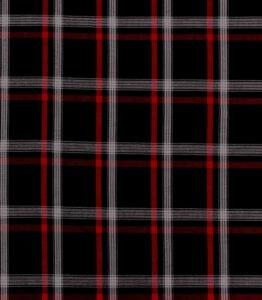
If you are a first-time buyer, you may miss this, but yarn-dyed fabrics are costlier when compared to piece-dyed fabrics. This is because of the additional dyeing process that happens before the weaving process. Because of this, the fabrics look much more defined and have color depth.
Many buyers often choose yarn-dyed fabrics for making striped and check garments. They are willing to pay the additional cost to get the desired fabric. Check out the article on yarn dyed fabrics to learn more about it.
Certifications Can Also Affect Pricing
Sustainability certifications are becoming a must-have for the export market. Buyers are constantly asking for it. Standards like GOTS, OEKO-TEX®, BCI, and FSC® can significantly increase the manufacturing costs because of the need for compliance requirements, audits, documentation, and traceability processes.
Read more about sustainable fabrics here to understand responsible sourcing practices.
Why Extremely Cheap Fabric Quotations Can Be Misleading
Fabric sourcing managers are often met with this dilemma. That is, different manufacturers quote different prices for the same fabric requirement. One supplier cost cheaper and the other costs more. Have you ever wondered why?
In some cases, the difference is in a genuine efficiency advantage. But some are not. They use malpractices and manufacture items without ethics. And if you look closely, the specifications may not be identical. There can be slight changes in yarn count, GSM, weave density, and other factors that are not easy to identify with a normal quality check. This is why sampling is important in the buying process.
Sampling Usually Reveals The Real Difference
While a quotation tells you the price, a sample tells you the reality. When suppliers send you the sample of the fabric, you will immediately know which one is better and which one is not. When you hold a piece of fabric to feel the drape, texture, softness, etc., you can immediately know how it’s going to be in mass production.
This is the reason why experienced sourcing teams almost always request woven fabric samples before approving bulk production.
Understanding Fabric Construction
Apart from the GSM, dyeing, blends, etc., fabric construction also determines the price of the fabric. Because the weave of the fabric defines the performance and appearance. A plain weave fabric can behave differently compared to a twill or satin weave construction. We discussed this topic in detail in our recent article on plain vs twill vs satin fabric.
Final Thoughts
The wholesale woven fabric price guide is about helping buyers understand the nuances in buying fabrics. When it comes to linen, cotton, and canvas, the pricing factors are different, although they also have common factors like GSM, weaving, finishing, dyeing, etc. This is the reason why the cheapest fabric is not always the most economical one. If you are a sourcing manager, also remember that the quotation is just a number; there is a whole lot of things that will decide the actual cost.
Frequently Asked Questions
What is the average wholesale cotton fabric price in India?
Between ₹80 and ₹350 per meter, depending on various factors like GSM, weave, etc.
Why is linen fabric more expensive than cotton?
Because linen is more costly to produce and manufacture.
Does fabric GSM affect pricing?
Yes, higher the GSM, higher the cost because of the resources used.
Why are yarn-dyed fabrics more expensive?
Additional dyeing is required for the yarns before it goes into the weaving process, and because of this, the prices are higher for yarn-dyed fabrics.