
TL;DR
Woven fabric is made by weaving or intertwining two yarns together. These are called the warp yarn and the weft yarn. It is a simple process, yet its manufacturing is complex. A small change in yarn, weave, or the finishing process can completely change how it looks in the end.
Woven Fabrics are Basic
Having only just two yarns crossing each other may look straightforward to many outsiders. It’s simple to explain, and they are not wrong. But the people who are working with woven know that it’s not the whole picture. Only when you spend time in production will you know the nuances. Just how many variations come from small changes and carelessness? A slight change in yarn count, or a tweak in finishing, and the fabric behaves entirely differently. That is why woven fabrics look simple on the surface when it is actually not in practice.
Where Woven Fabric Comes From
The weaving process and making of woven fabrics have been around for a long time, even before handlooms. When people used to weave using just their hands. Then came the handlooms. These handlooms were inefficient, which was then replaced by the powerlooms we see in today’s world. Thanks to the Industrial Revolution. Even with all these changes, the structure still stays the same; the only change is how we produce it. With power looms, we were able to increase the speed of output and production. Without losing consistency. This is how woven fabrics moved from a small-scale operation to a large-scale industry. Now, most of the production is automated. High-speed looms are everywhere where the tension is controlled, and patterns are precise. But the warp and weft yarns still exist.
What Actually Defines a Woven Fabric
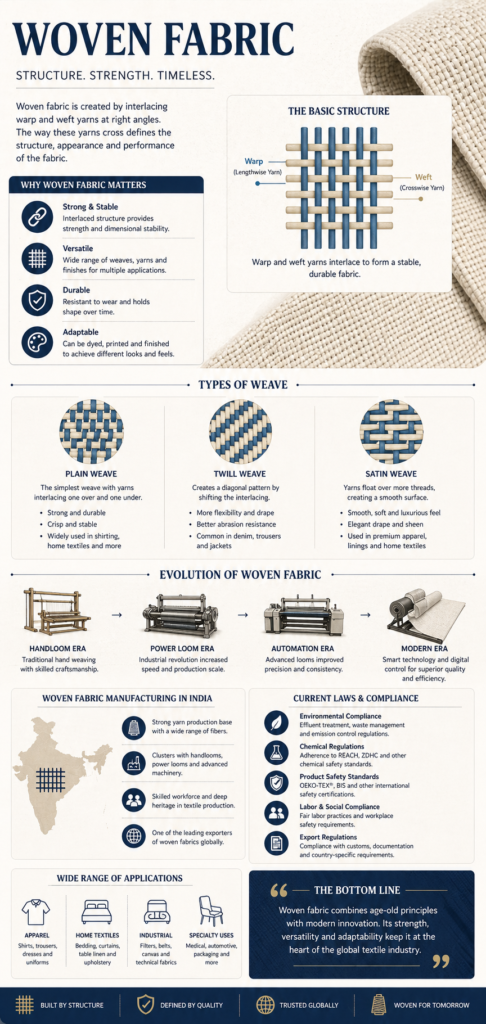
Woven fabric is defined as a fabric that is woven by interlacing two yarns. The warp yarn runs lengthwise, and the weft yarn runs across the fabric. The way they cross each other defines everything. I am not talking about just the look, but also its strength, flexibility, and how it reacts to various finishing processes like dyeing and treatments. In our recent article about the ripstop fabric, we talked about how structure affects performance. Feel free to read it to understand how small structural changes can have a big impact.
Types of Weaves That Define Everything
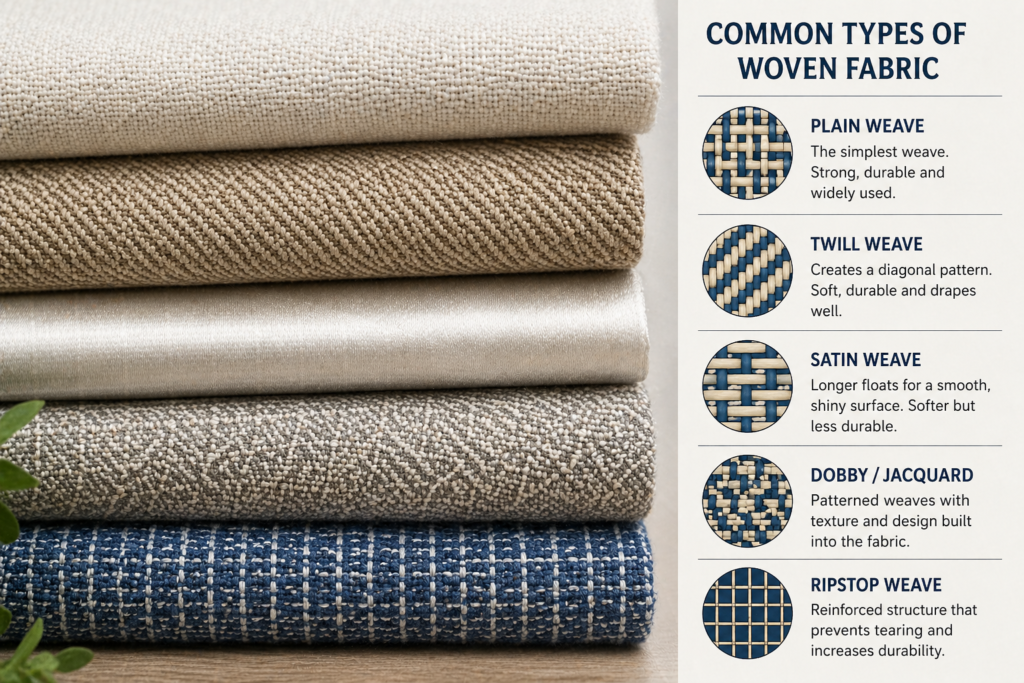
The type of weave always defines the fabric. Most fabric you see in the market comes from a plain weave. This is the most common. There are a few common or basic weave types. These variations are responsible for creating a wide range of results. Plain weave is the simplest one. You can read more about it in our recent article on plain weave fabric. Then we have the twill weave fabric. This is slightly different from the plain weave due to the reason how the yarns are interlaced. Instead of a straight line, the yarns are interlaced in a diagonal pattern. This is the reason why twill fabrics are more flexible and come with great drapes. Finally, we have the satin weave fabric, this weaving technique take sit a bit further. It is less interlacing and more surface exposure, creating a smooth finish. We have written in detail about satin weave fabric in our recent article. One thing to note down is that these are all the same concept, only the results are different due to how it’s woven.
A Small Change Can Shift the Fabric Completely
Do you know that even with the same weave, the results can be different? This is something that is not talked about often in our industry. What I am talking about here is the yarn count, tension in the loom, and the final finishing processes. Even with keeping the weave the same and changing any of these mentioned, the end result is going to vary. So as a sourcing manager, you need to make sure that not only the weaving is consistent, but also all the other minute details are kept the same.
How Woven Fabric Is Manufactured in India
Even with a lot of advancements in the woven fabric industry, India is both advanced and backwards at the same time. In a good way. There are manufacturing companies that use the most advanced looms and processes, with an output matching that of any other country out there. At the same time, there are still artisans that uses handlooms and keep local art alive even after generations. These traditional handloom clusters are seen throughout India and in the corners of each state. So whatever you are looking for as a sourcing manager, you get exactly that.
The Role of Yarn in Final Fabric Performance
So, in the earlier section, we talked about how the change in yarn can completely change the output of the production process. When most people focus on the weave, the real experts also focus on other parts of the manufacturing process, like the yarn it uses. Yarns play an important role in the manufacturing process, and they cannot be ignored. Differences in count, twist, or even slight irregularities in the yarn can alter the end result. We talked about this in our recent article on cotton slub fabric, where the yarn is used to create a distinct variation in the fabric, right in the weaving process. So that is why we say that the weave defines structure, and yarn defines character for the fabric.
Dyeing and Finishing Add Another Layer
Once the weaving is complete, and you have used the right yarn for it, the process is not complete. The dyeing and finishing process is the final step. Dyeing and finishing give the fabric the color, softness, surface feel, and all the good things that come with the fabric. And this needs to be controlled carefully.
In our recent article, we discussed the criteria for selecting dyes by fiber content. Feel free to check it out if you’d like to know more about how both fiber and structure affect how dye behaves.
Current Regulations and Compliance in the Industry
With the Industrial Revolution, the amount of fabric that is exported internationally also increased. This created a lot of problems for buyers and manufacturers, as each individual buyer and manufacturer had their own process and quality checking criteria. In order to solve this issue, global standards and certifications were introduced. This is something that has changed over time. At Dinesh Exports, we follow strict international guidelines and hold various certifications like the OEKO-TEX, OCS, Fair Trade, etc to keep standards expected by international buyers. These guidelines are around sourcing, the use of chemicals, and labour practices. For us, this is not optional, but mandatory. This directly affects whether a fabric can be sold in certain markets.
Where Woven Fabric Still Dominates
Woven fabrics are still used in various everyday items like shirts, trousers, uniforms, home textiles, and other uses both home and industrial. All these categories rely heavily on woven structures because each of them is unique in use cases.
Sampling Is Where Everything Becomes Clear
Sampling is the process by which the manufacturer sends a piece of the fabric to the buyer according to the specifications that they want to manufacture. This is to give an idea or to see the fabric in real before anyone commits to a large production. Imagine a large production is completed without sampling. You might notice small details that you are not comfortable with. This will lead to huge losses for both parties. In our recent article on a woven sample, we talked about the importance of sampling in detail.
About the Supplier Behind These Fabrics
Dinesh Exports is a woven fabric manufacturer based in Erode, India. We have been providing woven fabrics to various domestic and international brands for over 3 decades. The points that we talked about earlier in this article we apply them in our daily production process. We focus on quality yarns, a consistent weaving process, and finishing to ensure the final result is as expected by our clients. If you’d like to know more about our sustainability certifications, process, or any enquiries, feel free to contact us.
Final Thoughts
Woven fabrics have not really changed since their inception, even before the handlooms. What really changes is how it’s produced and catered to people all over the world. It is still warp and weft crossing each other. If you are a sourcing manager or a brand looking for a reliable woven fabric manufacturer in India, then you need to make sure that you are choosing a manufacturer that understands the consistencies required in the process to ensure you have the best products.
Frequently Asked Questions
What is woven fabric?
It is a fabric made by intertwining two yarns called warp and weft.
What are the main types of weaves?
The three main types of weaves are called the plain weave, twill weave, and satin weave.
Is woven fabric strong?
Yes, woven fabric is strong, but it depends on the type of weave and the count of the yarn.
Where is woven fabric used?
It is used in a wide range of products, both home and industrial applications.
Why is woven fabric widely used?
It offers durability, structure, and versatility across different applications.

[…] fabrics that come out of the loom shed are in greige form. After the weaving process, fabrics are passed through various wet processing to achieve desired feel and properties. In this […]
[…] Woven Fabric: Everything You Need to Know […]