TL;DR
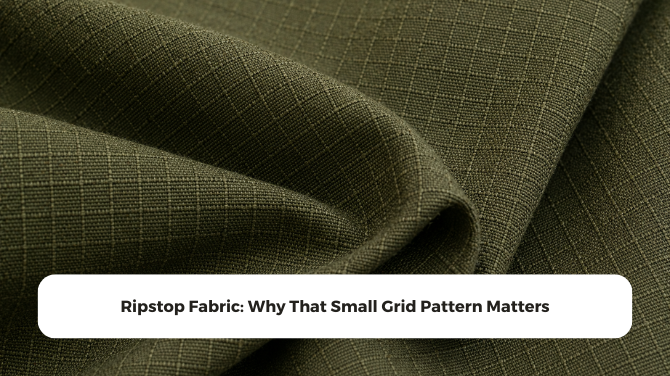
Ripstop fabric is designed to stop small tears from spreading. The grid pattern you see is not decorative. It’s built into the structure to improve durability without adding too much weight.
Check out our digital swatch collection here
You’ve Probably Seen It Without Realizing
Most people don’t notice ripstop fabric the first time they come across it. From a distance, it looks like a regular fabric. But when you look closely, there’s a faint grid pattern running through it, small squares that repeat across the surface. That detail is easy to miss, but it’s actually the most important part of the fabric.
The grid is not there for visual appeal. It’s structural. Once you understand what it does, you start noticing ripstop everywhere, especially in outdoor clothing, bags, and workwear. It’s one of those details that quietly does its job without drawing too much attention.
What Ripstop Fabric Actually Is
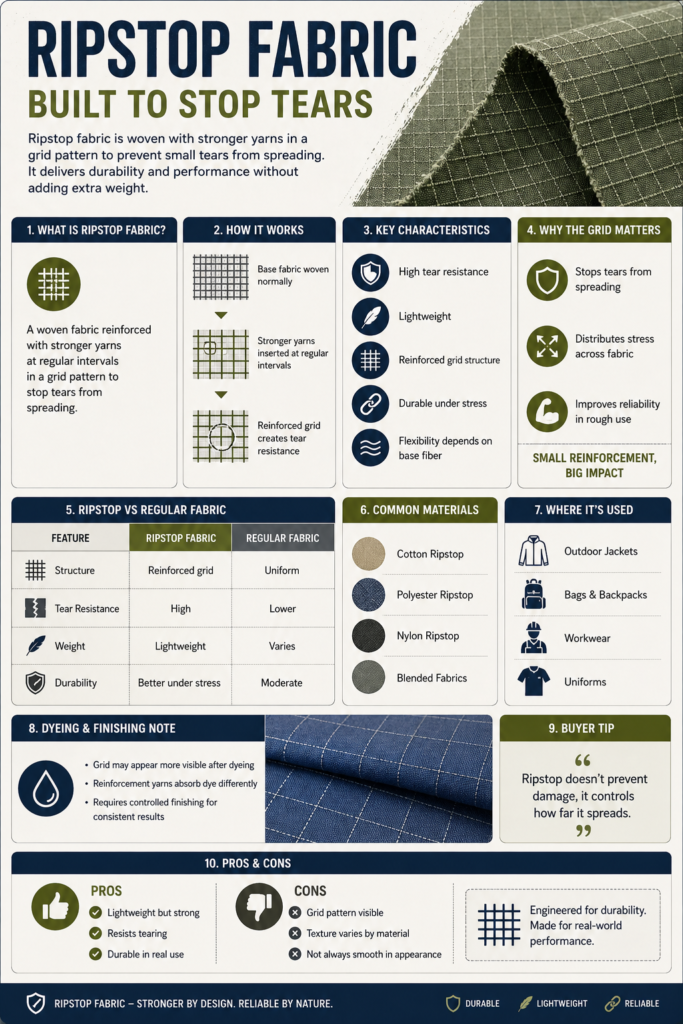
Ripstop fabric is produced by strengthening a base fabric with stronger threads at regular intervals. These threads are woven in both directions, forming a grid that splits the fabric into small squares.
If a tear starts, it doesn’t travel easily across the fabric. It hits one of these reinforced yarns and slows down or stops. It’s a simple concept, but in practice, it makes a noticeable difference. If you’ve already explored how construction affects performance in woven fabrics, this is a good example of how a small structural change can improve functionality.
That Grid Pattern Isn’t Just for Looks
There’s a common assumption that the grid pattern is decorative, but it really isn’t. Those slightly thicker yarns are intentionally placed to act as barriers. When stress is applied to the fabric, the force doesn’t keep moving in one direction. It gets distributed across the grid.
In real life, this means that a small cut or snag is less likely to turn into a big tear. This is especially important when the fabric is going to be handled roughly or put under a lot of stress over and over again.
It’s Not Just One Type of Fabric
Ripstop is not a fiber, and it’s not limited to one type of fabric. It’s a construction method. You can find it in cotton, polyester, nylon, and various blends, and each one behaves differently.
Cotton ripstop fabric may feel more natural and comfortable, especially for clothes. On the other hand, nylon or polyester ripstop fabrics are lighter and are often used in outdoor gear where weight is more important. So when someone refers to ripstop fabric, it’s always worth asking what the base material is, because that changes how it performs.
How It’s Made
The base structure of ripstop fabric is similar to standard weaving methods. In many cases, it starts with a construction similar to plain weave fabric, where warp and weft yarns interlace in a consistent pattern. The difference is that at regular intervals, thicker reinforcement yarns are added.
These yarns are thicker and stronger, and they make the grid pattern you see. The space between them can change depending on how the fabric will be used. Smaller grids are usually used in lighter fabrics, while larger grids are seen in heavier applications.
Strength Without Extra Weight
One of the main reasons ripstop fabric is used is because it offers a balance between strength and weight. Normally, increasing durability means increasing thickness or density. That adds weight, which isn’t always desirable.
Ripstop approaches this differently by reinforcing only specific areas. This allows the fabric to stay relatively lightweight while still improving tear resistance. It’s a practical solution, especially in applications where both durability and weight matter.
Where Ripstop Fabric Works Best
Ripstop fabric is best for things that need to be able to handle stress without breaking easily. Outdoor clothing is a common example. Ripstop construction is often used in jackets and pants made for rough conditions because it makes them stronger without making them heavy.
It’s also widely used in bags and backpacks, where tearing can be a common issue. In some cases, workwear and uniforms also use ripstop fabrics for the same reason. Compared to smoother constructions like satin weave, ripstop is clearly focused on performance rather than appearance.
It Doesn’t Always Feel the Same
One thing that stands out with ripstop fabric is that it doesn’t have a single consistent feel. The texture can vary quite a bit depending on the material and finishing. Some ripstop fabrics feel soft and flexible, while others feel slightly crisp or structured.
Cotton-based ripstop fabrics tend to be more comfortable for apparel, while synthetic versions may feel more technical. This variation is something that can’t be judged purely by looking at specifications.
Dyeing and Finishing Differences
Dyeing ripstop fabric can sometimes make the grid pattern more visible. Because the reinforcement yarns can absorb dye differently, the grid may stand out slightly after processing. This isn’t necessarily a flaw, but it’s something to be aware of during development.
We’ve seen similar effects in criteria for selecting dyes by fibre content, where both fiber type and structure influence how the final color appears. With ripstop, that structural variation plays a role in the final look.
Why Sampling Matters
On paper, ripstop fabric can seem straightforward, but the sample is where the real understanding comes in. The visibility of the grid, the feel of the fabric, and how it behaves under handling are things that only become clear when you actually work with it.
This is why sampling becomes important before moving into production. As we’ve seen in woven sample, small details that seem minor at first can have a noticeable impact later.
About Dinesh Exports
Producing ripstop fabric requires control across multiple stages, from yarn selection to weaving and finishing. The placement of reinforcement yarns needs to be consistent, and even small variations can affect how the fabric performs.
Dinesh Exports has been working with woven fabrics for more than 30 years, making both standard and more specialized products. Our main goal is to keep things the same from sampling to bulk production, which is especially important in fabrics where structure is important.
We also work with certified materials and processes, which help meet export requirements and buyer expectations. For anyone sourcing functional fabrics like ripstop, that level of experience can make a difference in how the final product performs. For more details, please contact us.
Final Thoughts
Ripstop fabric is not complicated once you understand what it’s trying to do. That grid pattern is there to control how the fabric behaves when it’s under stress. It doesn’t prevent damage completely, but it limits how far it can spread. In many applications, that’s exactly what’s needed. It’s not about making a fabric perfect, it’s about making it more reliable.
Frequently Asked Questions
What is this fabric?
Ripstop fabric is a woven fabric reinforced with stronger yarns in a grid pattern to prevent tears from spreading.
Is it a strong fabric?
Yes, it is designed to improve tear resistance while remaining lightweight.
Is it waterproof?
No, it is not inherently waterproof. Water resistance depends on additional coatings or finishes.
What is it used for?
It is commonly used in outdoor clothing, bags, uniforms, and workwear.
Is it breathable?
Breathability depends on the base material, with cotton versions generally being more breathable than synthetic ones.