When we work on lean improvement projects, the goal is not simply to identify waste and suggest a solution. We need a structured approach that helps us understand the problem, measure the current situation, identify the real cause, and make sure the improvement continues after the project is completed.
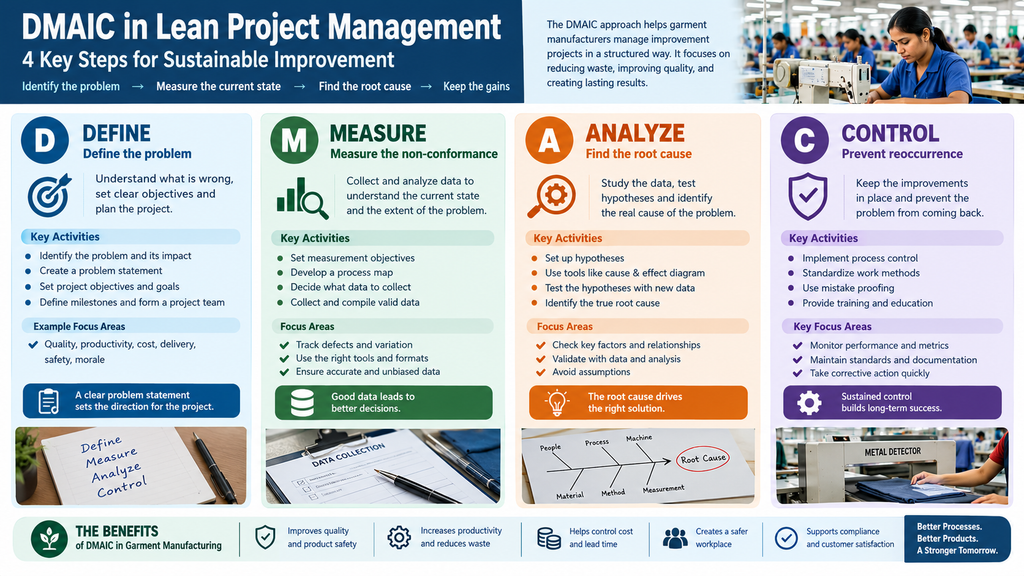
This is where the DMAIC approach becomes useful. DMAIC stands for Define, Measure, Analyze, and Control, and it provides a practical framework for managing improvement projects systematically.
In garment manufacturing, this approach can be applied to problems related to quality, productivity, cost, delivery, safety, and other areas of factory performance.
Check out our digital swatch here
Lean Projects and Waste Elimination
Waste elimination from a process is one of the core objectives of the lean project implementation. Waste elimination program is implemented project-by-project. For lean 3 types of projects can be taken up –
- Quality improvement projects
- Cost reduction projects
- Lead time reduction projects
Every project should have a formal starting and a completion date. Waste elimination project has to be completed in a period of 12-16 weeks (exception may be in some special cases, but it should be avoided)
DMAIC approach to project management
Step#1 Define Phase: (D – Define the problem in terms of what is wrong)
The very first step in successful problem solving is defining it in a way that it can be easily solved. Let’s define the problem.
What is a problem?
- A problem is undesirable result of a process
- A problem is a cause of shortfall between a target (desired state) and the current state.
- The intensity of a problem depends on the variance of the current situation from the targeted value.
- A problem is an opportunity for improvement
- Eliminating the causes of the shortfall between the target and actual is called as Problem Solving.
Following steps may be applied for effective problem definition:
- Understand the problem
- Develop a problem statement
- Set the project objective and goals
- Define the milestones for project completion
- Form a project team and describe the role of team members
1.1 Understanding the Problem
Understand the nature of the problem the which needs to be solved.
- Is quality a problem?
- Is productivity a problem?
- Is cost a problem?
- Is delivery a problem
- Is safety a problem?
- Is morale a problem?
Assess the damage: how much damage does the problem cause? How much qualitative, quantitative and financial impact does it make?
Understand the subsequent processes: how the next process is impacted by the problem?
Identify key focus areas: key focus areas are those aspects of problem which are given special attention. Based on the focus, limited resources available with the project team has to be deployed to accomplish the project in given time.
1.2 Develop a problem statement
Develop a problem statement that accurately and clearly describes the current condition. Consider the following questions:
- Is problem stated objectively?
- Is the problem limited in scope?
- Do all concerned people of a project team and improvement activities have a common understanding of the problem?
Characteristics of a problem statement includes:
- What is wrong?
- Where the problem occurs?
- When it happens? How long it has been?
- How big is the problem?
- What is economic impact of the problem?
Example: Problem statement
During March to June (when), rejection from unit 2 (where) has reached to 6% (what), which is 2% percent higher than the previous quarter. This has resulted in a loss of 4 lakh to the company (impact).
Setting improvement objectives
Objectives and goals: Objectives are guiding principles that direct the efforts of team members in their contribution to the project goal.
Establish specific quantitative objectives in terms of:
- What: the item or the characteristic evaluated?
- To what extent: the target value to be reached:
- When: delivery date, date of completion?
1.3 Goal statement
- Goal statement defines the improvement (result) project team is seeking to accomplish.
- Starts with a verb (reduce, eliminate, control, increase, improve etc.)
- Provides measurable targets with a completion date
- Statement is actionable and sets the focus, motivates team
- Does not include the presumed cause or prescribed solutions.
Example goal statement:
Reduce the rejection rate at unit 2 from current level to 2% by the end of next quarter ending 30th September.
1.4 Define milestones for project completion:
It is not enough to have goals and objective only; you need checkpoints and activities to get your project to the goal and objectives. Otherwise, how can you ensure that you are going in right direction?
- Periodic checkpoints help you to measure the project progress
- Milestones are the long term checkpoints. They are used to measure actual versus planned progress of the project
- Develop a comprehensive project schedule right from start to finish
Step#2: Measure Phase (M – Measure the non-conformance / abnormality)
The main activities of measure phase are:
- Clarify measurement objectives
- Develop process map
- Decide what data to be collected
- Collect and compile valid data
Measurement objectives: measurement activity gathers data to establish “current state” what is actually going on in the work place. The objective of measurement is to collect all relevant data that describes the nature of the problem. To set the measurement objective, you need to address the following:
- What is your goal, or expected outcome for collecting data?
- What process will you measure to collect data?
- What data do you need to collect to meet your objectives?
Develop process map: to collect data project team has to study, understand and observe the processes where the problem exists. A process map is a tool used to understand and analyze the process. The process map is a graphical presentation of steps, events, operations, and relationships of resources within a process.
Decide what data to be collected: using the project goal and process map, decide:
- What data is needed?
- Clarify the operational definition of each measurement
- Determine the measurement methods that will be required
- Determine the sample size
- Make a data collection plan
Collect Data: collect data on the relationship between defects (result) and various factors that influence it. Collect data impartially. Do not collect only data that is easy and convenient to collect. Investigate from many different points of view to discover variation in the results. Design appropriate formats for data collection. Compile data in appropriate format that can facilitate correct and quick analysis.
Step#3: Analyze Phase (A – Analyze the situation to establish root cause)
As explained earlier the objective of the analysis is to reach the root cause of the problem. This step is divided into two parts.
- Set up hypotheses &
- Test the hypotheses
Hypotheses – Hypotheses is a proposition made as the basis for reasoning. It is the starting point for further investigation from known facts. It involves selection of major factors and causes.
How to set up hypotheses?
- Prepare a cause & effect diagram so as to collect all knowledge concerning possible causes
- Use the information collected during measure phase and delete any data which are not clearly relevant. Revise the C&E diagram.
- Select these elements in the latter diagram which seems to have a high possibility of being main causes.
Testing the hypotheses:
Building the hypotheses and testing the hypotheses are two different things, same data cannot be used for both. Verification of hypotheses requires new data not used for building hypotheses. Testing involves deriving the main cause from selected main factors.
- Tests of the hypotheses must be based on data obtained from experiments and surveys. The fresh data should be collected according to a carefully constructed plan.
- Testing the hypotheses is investigating whether a relationship actually exists between the possible causes and results and if does exists, how strong the relationship is? What effect the possible cause has?
- Finally, identify the true root cause for improvement action.
Step#4: Control phase (C- Control through prevention of reoccurrence)
This step is must in lean project management
- To make sure that system and processes stay in controlled condition after problem is solved
- To hold the gains of improvement
- To quickly detect the “out of control” state and take immediate corrective and preventive action
To hold the gain of improvement following control must be taken by the project teams:
- Process control
- Standardization
- Mistake proofing
- Education and training
What is process control?
A control mechanism, which ensures that process performance is maintained at a level that satisfies customer’s requirements and drives the ongoing improvement of process performance.
Elements of process control
- Documentation of the process
- Process metrics
- Process monitoring
- Ability to take prompt action in “out of control” situation
Standardization
- Make the changes in work methods permanent by standardizing procedures and methods.
- The relationship between the standardization and quality is very close. The quality problem such as generation of defects occurring in the daily process, higher cost of poor quality, wrong delivery etc are mainly because of poor work standards or absence of standardization in the organization.
- Standardization is the organizational action to set standards and use them, not simply establish them.
- Standards related to cost, performance, operating practices, inputs, and outputs should be established, maintained, periodically reviewed and improved.
- Integrate the work standards into the job.
- Standards are controlling mechanism to maintain operating discipline in the organization.
Education and Training
- Even if the company standards are made and distributed to the concerned people, it may not have the desired effect, as it may not be read.
- Even if they are read, it might be not well understood.
- Even if the standards are understood, it may be difficult to implement.
- In several organizations, people feel pride in violating the standards. This particular habit of people calls for proper education and training.
- Improvements made by project teams, need to be understood and adopted by the people, which requires the change in attitude, knowledge, and skills. This change can be brought by proper education and training.
About Dinesh Exports
At Dinesh Exports, we’ve been working with the textile and apparel industry for more than three decades. Over the years, we’ve seen how important process discipline, consistency, quality, and continuous improvement are to successful manufacturing.
As a woven fabric manufacturer in India, we work with apparel brands and garment manufacturers supplying fabrics for different product requirements. Our experience across cotton, linen blends, Lyocell, yarn-dyed and other woven fabrics gives us a practical understanding of how fabric quality and manufacturing processes can affect the downstream production process.
For us, continuous improvement is not only about reducing waste. It is also about creating more consistent processes, improving quality, reducing unnecessary delays, and delivering reliable products to our customers.
If you’re looking for a woven fabric manufacturing partner from India, we can help you explore fabric options based on your product and production requirements. Contact us here.
Conclusion
A lean project needs more than a good idea. It needs a structured process for understanding the problem, measuring what is happening, finding the actual root cause, and making sure that the improvement remains in place.
The DMAIC approach provides this structure through four important stages: Define, Measure, Analyze, and Control. Each stage has a specific purpose, from creating a clear problem statement to establishing standards and training people after an improvement has been implemented.
For garment manufacturers, this approach can be useful for tackling problems related to quality, productivity, cost, delivery, safety, and other areas of factory performance. When the project team follows each step carefully and uses data rather than assumptions, the chances of achieving a sustainable improvement become much stronger.