
Don’t be intimidated by the word GSM if you are hearing this for the first time in a meeting with a vendor. Most people don’t know what it is. Fabric GSM is the basic measurement item for any type of fabric or garment production.
But most people only look at the fabric texture, softness, color, etc., of the fabric first. GSM plays an important role in determining how a fabric actually feels, whether it is its breathability, how it drapes, and sometimes how premium it feels. This article is all about fabric GSM and all you need to know about it.
Check out our digital swatch here.
What Is Fabric GSM?
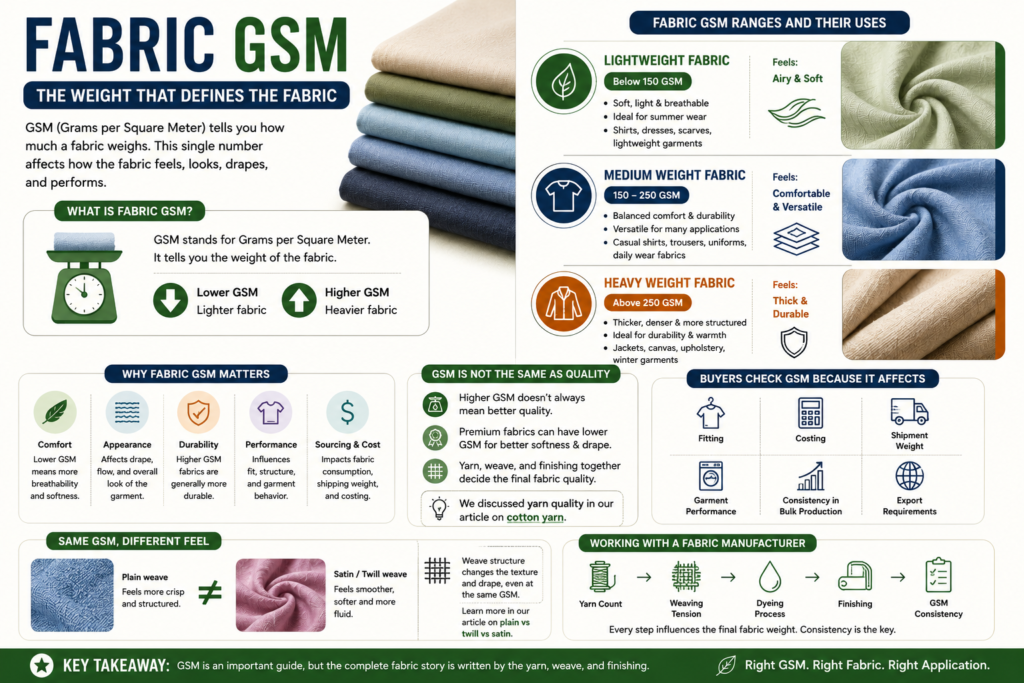
GSM in fabric: GSM stands for grams per square meter. It is how you can understand how much a fabric weighs. The higher the GSM, the heavier the fabric gets. In the same way, a low GSM means a lighter fabric. This is the technical meaning of it.
But in textile manufacturing, fabric GSM can also be used as a quick way to understand how a fabric behaves. For example, when you are interacting with buyers or production units, and they say that the fabric is 120 gsm, you can already visualize roughly how that fabric is going to behave, whether it is going to be lightweight or heavyweight. Now, what are you going to issue if I say a fabric is 300 gsm? You guessed it right!
Why Fabric GSM Matters So Much
GSM is not just another number in a specification sheet. It may look that way at first. But believe me, it is not. Actually, it affects almost everything. As we already saw, lower GSM means lighter fabrics, which are ideal for summer fabrics and garments. It also decides how it appears on the final product.
Some lower GSM fabrics drape softly and can move very easily. This is the reason why buyers always ask for GSM of the fabric and make it a point to set it during the initial talks of sampling woven fabrics.
3 Different Fabric GSM Ranges And Their Uses
1. Lightweight Fabric GSM
These fabrics are categorized as lower than 150 GSM fabrics. It is commonly used in shirts, summer dresses, scarves, and other lightweight garments. Since the fabric feels softer and more airy, there will be less material on the surface. A lot of lightweight woven fabrics fall into this category.
2. Medium Weight Fabric GSM
Fabrics between 150 – 250 gsm are categorized as medium-weight fabric. It is the type of fabric buyers go for when they want something that is durable. Mostly used in shirts, trousers, uniforms, and other daily wear items. It is also quite common in different woven fabric manufacturing applications because of how versatile it is.
3. Heavy Weight Fabric GSM
Fabrics above 250 GSM are considered heavyweight fabrics. These are thicker, denser, and more structured, and they’re mostly used in jackets, canvas products, upholstery fabrics, and other winter garments. In some cases, heavyweight fabric can feel stiff, but it is due to the application of it.
Fabric GSM Is Not The Same As Fabric Quality
This could be one of the biggest misconceptions that we are going to debunk. Higher GSM does not equal better quality fabric. Some premium fabric manufacturers actually prefer lower GSM fabrics for their products so that it is soft and can drape easily. They do not consider thickness that well. This is the reason why we say higher GSM does not equal higher quality. We discussed something similar in our recent article on cotton yarn, where we discussed how yarn quality changes the fabric’s behavior.
It is worth pointing out that the weave structure also plays a role in determining the fabric’s feel and performance. You can see this difference in plain vs twill vs satin fabric comparison.
Why Buyers Usually Check GSM Before Bulk Orders
Now that we know what fabric gsm is, you may wonder why buyers usually check it before bulk orders. Because it will affect fitting, costing, shipment weight, and the entire garment production. Even a small variation in the GSM can alter the whole planning process which is why buyers confirm the final GSM before approving final production. In woven fabric exports, this is especially true where consistency matters across repeat orders and yarn-dyed fabric developments.
Fabric Construction Also Changes GSM Feel
This is a surprising part for many people. Yes, two fabrics can have the same GSM and still feel completely different due to their construction. A tightly woven plain fabric behaves differently compared to a softer satin weave or twill weave.
Working With A Fabric Manufacturer
If you are looking for a reliable woven fabric manufacturer that can control the GSM consistently across production, then you need to be looking for a manufacturer like Dinesh Exports that comes with more than three decades of experience. We make sure that the yarn count, weaving tension, dyeing process, and finishing stay consistent across the production process.
Final Thoughts
While fabric GSM may sound like just another metric in a spreadsheet, it is an important technical detail that affects everything in the production process. It is the reason for how the fabric feels, appears, durability, how the garment behaves, and how it is sourced. But at the same time, GSM alone does not determine the quality of the fabric. It is only meaningful when combined with proper yarn quality, weaving structure, and finishing control.
Frequently Asked Questions
What is fabric GSM?
GSM simply means grams per square meter in a fabric; it is the metric used for measuring the weight of a fabric.
What is considered a lightweight fabric GSM?
Any fabric that is lower than 150 GSM is considered a lightweight fabric.
Does higher GSM mean better quality?
Nope, it only indicates how much a fabric weighs overall.
Why is GSM important in textiles?
Because it can affect the fabric’s feel, breathability, draping, and overall garment production.
[…] Fabric GSM Explained […]
[…] Fabric GSM Explained […]
[…] Fabric GSM Explained […]
[…] Fabric GSM: Small Number Affecting Fabric ManufacturingRead the article […]