


TLDR
In late 2025, India replaced 29 old labour laws with four unified Labour Codes. These changes simplify compliance, expand social security and redefine wage and safety standards. For labour-intensive sectors like textiles, this means new challenges and opportunities in workforce management, cost planning, production scheduling and worker welfare.
Check out our Digital Swatch here
Most people outside HR teams think labour laws are something dusty, and only HR or legal should worry about them. But for textile exporters, garment units and sourcing teams, India’s labour reforms introduced in November 2025 are not remote legal updates. They affect costing, staffing, production hours, safety compliance and even export competitiveness.
This article explains the new rules simply, shows why the textile sector is paying attention, and what these codes mean for factories and buyers working in woven and apparel sourcing.
What exactly changed with the new Labour Codes
On 21 November 2025, the Government of India implemented four consolidated labour codes, replacing 29 older and fragmented laws. These cover:
- Code on Wages
- Industrial Relations Code
- Code on Social Security
- Occupational Safety, Health & Working Conditions Code The Economic Times
The switch from many overlapping laws to four unified ones is one of the biggest reforms in Indian workforce policy in decades. It simplifies registrations, compliance and compliance filings while bringing modern labour principles into practice. The Economic Times
These new codes aim to balance worker protections with easier business processes, including single registration, common returns filing and digital records. Online Clothing Study
Why the textile industry pays attention
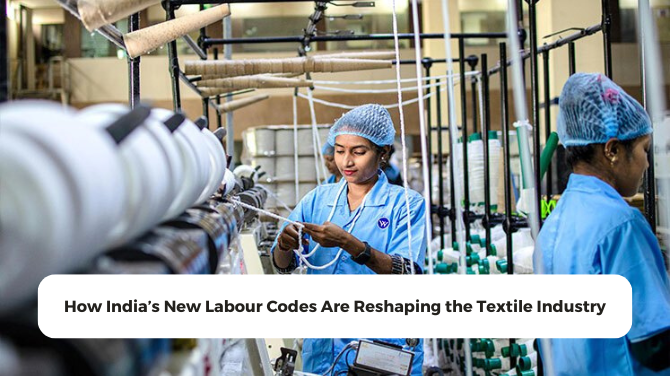
Textiles and garments are among the largest employers in India’s industrial workforce, with millions working in factories, mills, clusters and export houses. The new labour codes are expected to impact:
Uniform compliance across states
Older rules varied a lot from state to state, so textile units running in Tamil Nadu, Gujarat, Tiruppur or NCR often had to adjust locally. The new codes bring more national clarity. Fibre2Fashion
Safety and workplace norms
The Occupational Safety, Health & Working Conditions Code strengthens factory safety requirements, worker welfare and health measures, which are especially relevant in large spinning and weaving capacities. The Economic Times
Social security and inclusion
More workers, including those previously informal or contract based, now qualify for benefits like PF, ESIC and gratuity under clearer rules. This reduces the chances of disputes and boosts worker confidence. Press Information Bureau
Flexible workforce management
Fixed-term employment with equal benefits lets factories adjust their teams for seasonal demand such as peak exports without heavy red tape. Online Clothing Study
Key provisions that matter to textile and garment units
1. Code on Wages
A single definition of wages brings uniformity in minimum wages and overtime calculations. A national floor wage ensures no one is paid below a certain level across sectors. This affects labour cost modelling in textile hubs. The Times of India
2. Industrial Relations Code
This code aims to simplify dispute resolution, provide faster grievance processes and allow more flexible employment contracts. Textile production lines that depend on seasonal workers may find this useful. The Economic Times
3. Social Security Code
This pushes extended social security coverage, including provident fund, insurance and health schemes, and mandates benefits for workers beyond garment factories, including gig and platform workers who support supply chain logistics. mint
4. Occupational Safety, Health & Working Conditions Code
Formerly covered by laws like the Factories Act, 1948, this unified code modernizes safety standards and workplace welfare norms across industries. Textile units now align more easily with global compliance standards. The Times of India
What this means on the ground for textile factories
1. Clearer compliance but more documentation
The single registration and unified digital returns system mean less redundant paperwork, but factories must still be meticulous with records. Digital labour records, appointment letters, timely wage records and safety reports become critical.
This shift from paper confusion to structured data helps with audits and buyer compliance checks. The Economic Times
2. Social security welds loyalty but raises costs
Extending PF, ESIC and gratuity to more workers increases payroll outflows. Small and micro textile units that relied on informal arrangements may see payroll jumps. But stronger safety nets can reduce attrition and improve workforce reliability. Fibre2Fashion+1
3. Safety for women workers and night shift regulations
Women can now work night shifts with consent and mandated safety measures. This enables double-shift operations, boosting production capacity in weaving, dyeing, and stitching lines. mint
4. Formalising contract and gig segments
Factories that subcontract work or lean on informal teams must now provide stronger social security coverage and maintain standard employment documents. This aligns Indian factories more with global supply chain expectations. The Times of India
Concerns and debates in the industry
Not everyone is happy, though.
Trade unions have protested the reforms, saying they reduce job security and promote flexible hire-and-fire practices. India’s nationwide protests highlight deeper concerns about worker protections and job stability in a major industrial sector. Reuters
Smaller textile units, especially informal workshops, may struggle with costs tied to universal minimum wages and wider social security benefits. This is something that sourcing teams need to watch while planning partnerships with micro manufacturers. Moneycontrol
Balancing worker welfare with competitiveness
The textile industry has welcomed parts of the reform because simplified compliance and uniform standards help factories align with international trade agreements and sustainability audits. Fibre2Fashion
Industry voices also see opportunity in enhanced workplace safety norms and new dispute resolution mechanisms that reduce downtime and workplace friction, both valuable for high-output textile clusters. Fibre2Fashion
Looking ahead: what sourcing teams should watch
- Minimum wage changes across states, impacts cost sheets.
- ESIC and PF coverage limits, affects staffing budgets.
- Women’s safety regs, could improve shift productivity.
- Industrial relations reform, expect faster dispute handling.
- Formal employment records, crucial for brand compliance checks.
These topics are especially relevant if you work with export houses or multinational brands.
Conclusion
India’s new labour codes mark a big shift from old, fragmented laws to a unified modern framework. For the textile sector, one of the biggest employment generators, this means better clarity, stronger worker welfare, and smoother compliance. But it also means changes in cost planning, workforce documentation and production strategy.
Whether you are a merchandiser, sourcing manager, factory owner or HR head in textiles, understanding these reforms is now a must. Not just for audits and buyer checks, but for long-term planning in a global market that increasingly values both efficiency and worker dignity.
This labour law overhaul may be one of the biggest structural changes in decades for Indian industry. It matters because people, the workers, are at the heart of textile production. And if the laws help them stay safe, stable and fairly treated, the entire value chain benefits.
Looking for a reliable woven fabric manufacturer? Please contact us.